Shimbun.co.jp logo
Shimbun.co.jp Detective / Investigations / Noir Archive
日本語版 → Jump to Sources

Verified Facts (CONFIRMED)

Only what we can anchor
  • Date: December 10, 1968.[1]
  • Loss amount: ¥294,307,500 (commonly “300 million yen”).[1]
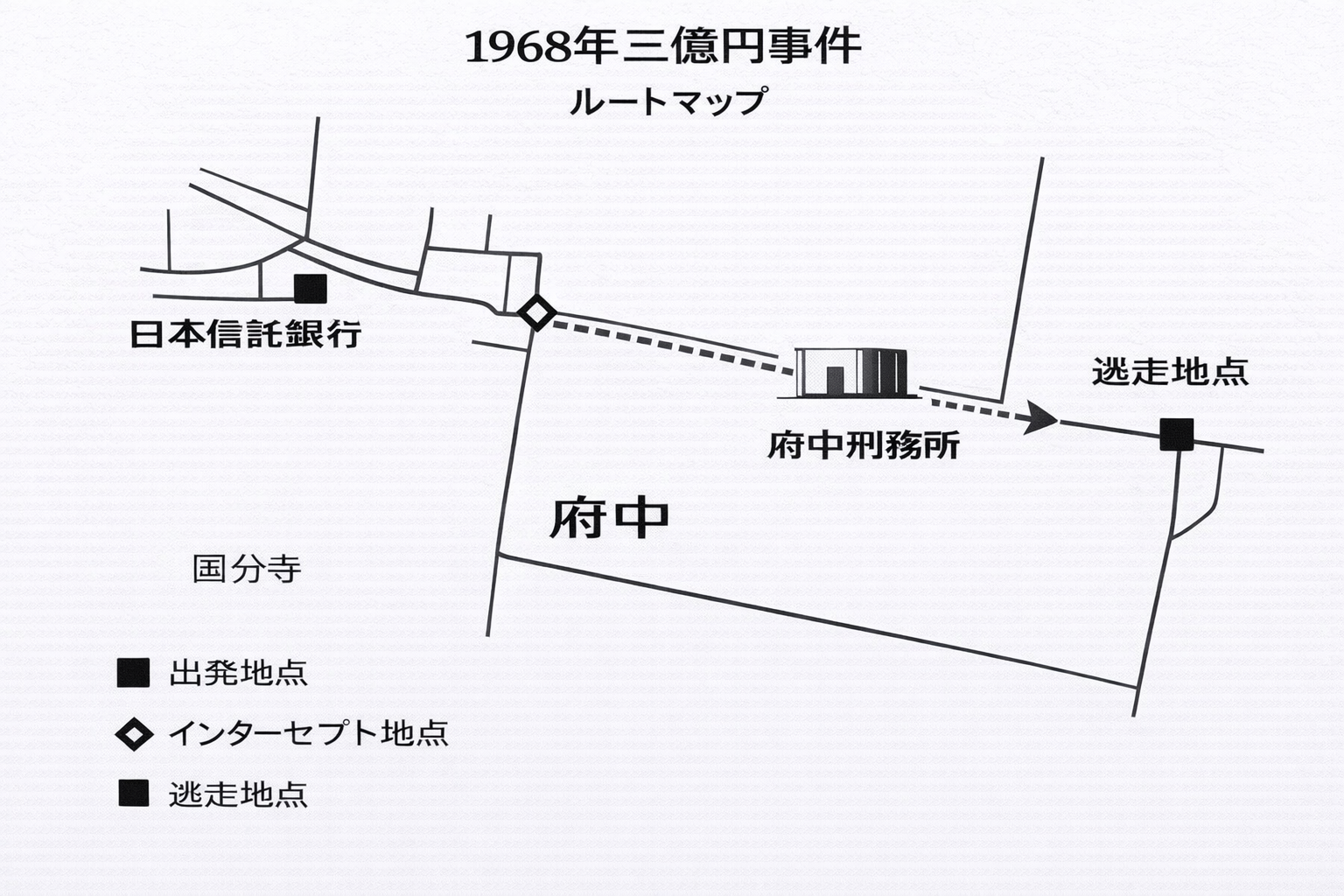
  • Location (broad): Fuchū City, Tokyo, Japan.[1]
  • Core method: a person posing as a motorcycle police officer stopped a cash-transport vehicle and used a bomb scare to force the crew away, then drove off in the vehicle.[1]
  • Outcome: no conviction; the case is widely described as unresolved after a statute-of-limitations expiry on Dec 10, 1975 in then-current practice reported in summaries.[1]
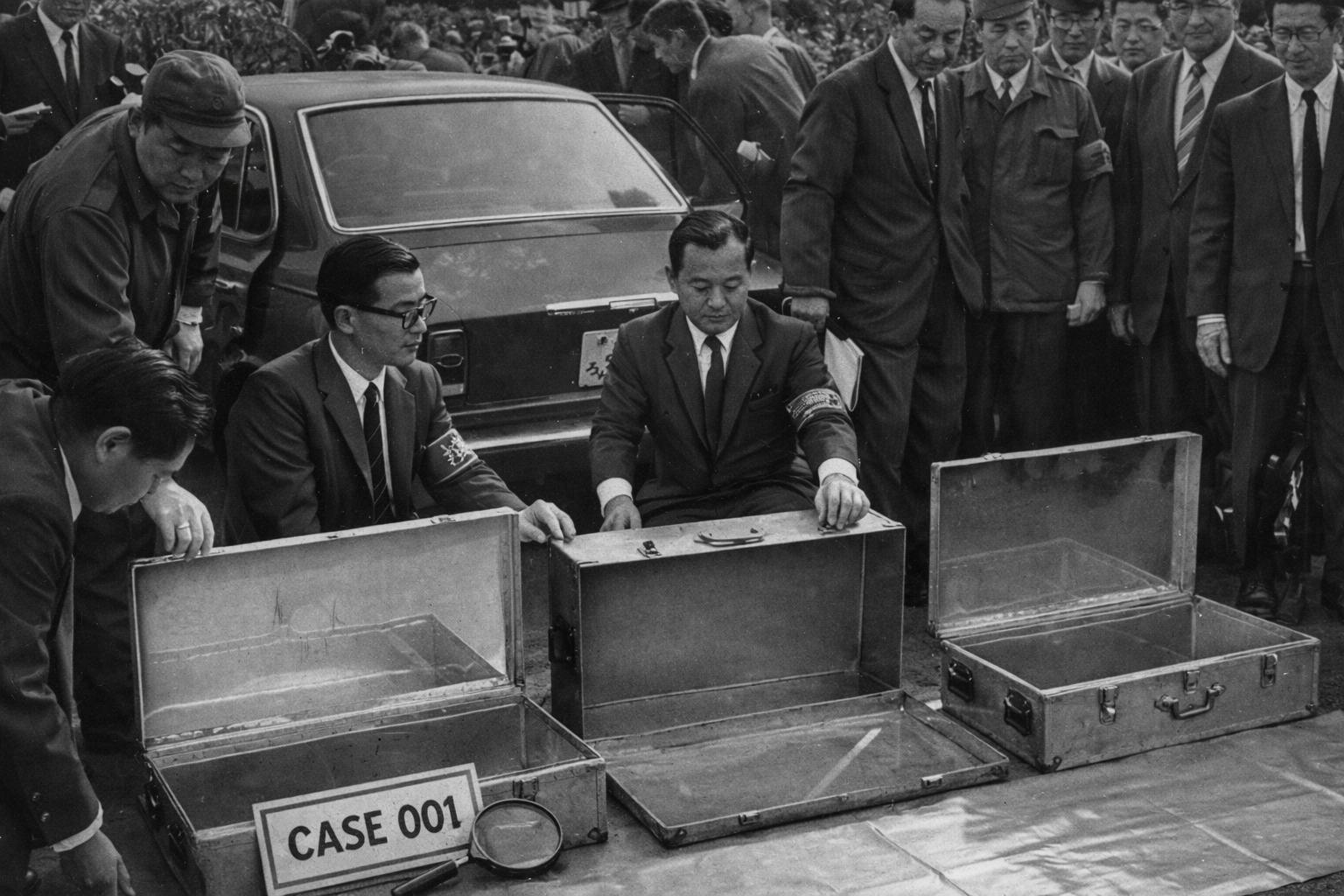
  • Archive caption corroboration: a photo-archive caption places the scene on a road north of Fuchū Prison and identifies the transport as tied to bonus funds and Nippon Trust Bank (Kokubunji branch).[2]

Editorial rule: If a fact appears in only a single secondary source, it stays REPORTED until a stronger archive / primary-ish reference is added.
Reported Details (REPORTED)

Commonly stated — but not uniform across sources
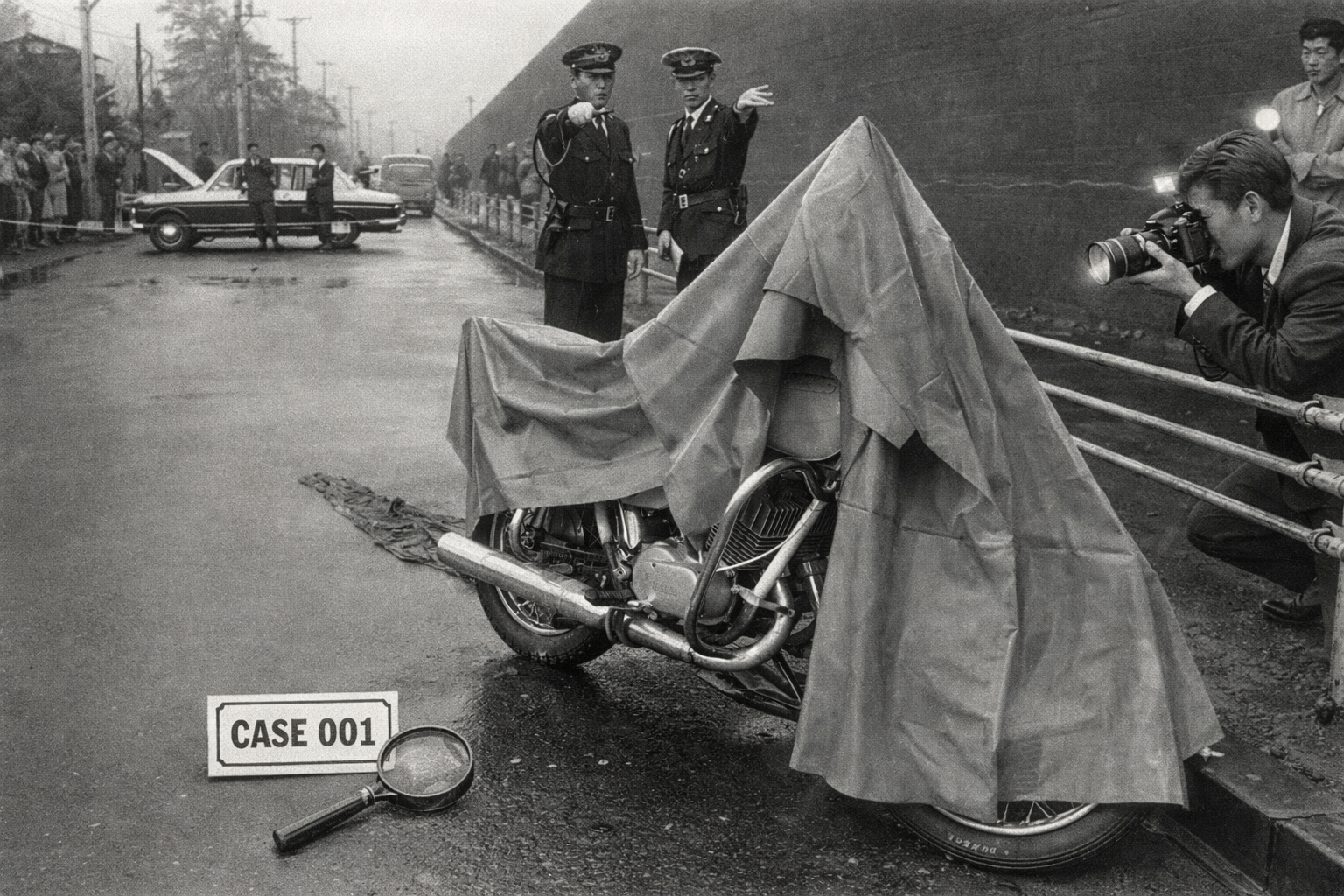
  • Exact scene: “Fuchū Prison north-side road” appears in multiple photo-archive / editorial captions.[2][3]
  • Street-level wording: some local historical reporting describes the address area as Harumi-chō 4-chōme and the road as “Gakuen-dōri.”[4]
  • Ruse line: a local long-form write-up quotes a “branch manager’s home was bombed…” style opening line; this varies by retellings and needs a contemporaneous newspaper anchor to promote to CONFIRMED.[4]
  • Duration: often described as “about 3 minutes” (or “3–4 minutes”).[1][4]
  • Injury count: commonly stated as no deaths and no injuries (verify against primary coverage when added).[4]
Why we keep this separate: “Reported” is not “false.” It’s simply not locked down to a single documentary anchor yet.

How It Worked (Mechanism, not myth)

A minimal, repeatable structure

Most summaries agree the “magic” wasn’t violence — it was stage management: authority signal → credible fear → forced distance → vehicle takeover.[1]

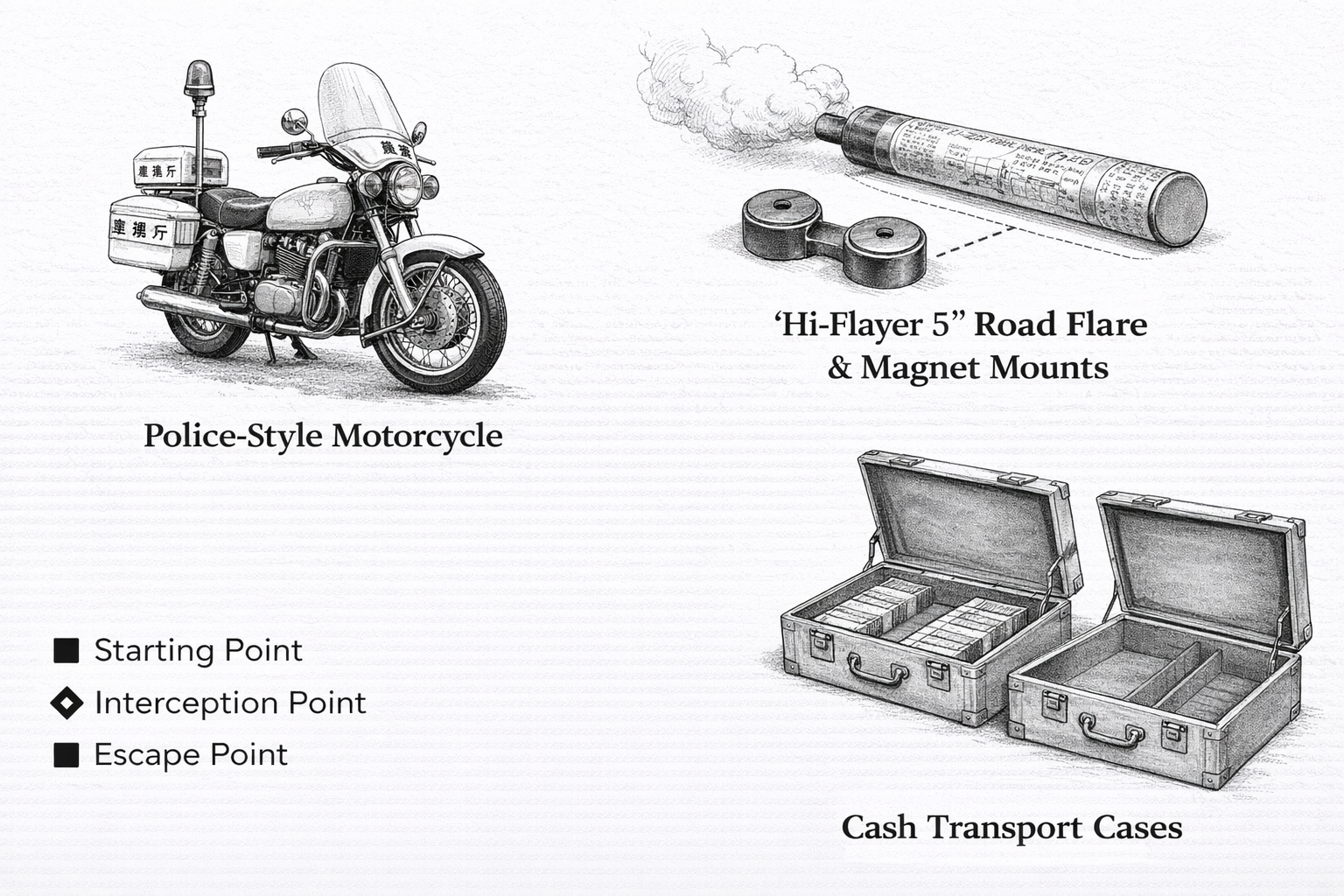
1) Authority (uniform + police-bike cue)

  • The disguise short-circuits normal verification and makes “stop” feel like routine compliance.[1]

2) Fear (bomb warning)

  • A bomb scare shifts attention away from the person and onto “the underside of the car.”[1]
  • Retellings commonly mention smoke/flares used to create urgency; specifics differ by source.[4]

3) Distance (smoke/flame zone)

  • Once the crew steps away, the thief’s problem becomes simple: get in, drive away.[1]

4) Exit (win early)

  • Short-duration cases typically imply planning around a secondary scene and vehicle disposal — but those details must be anchored before being stated as fact here. DISPUTED
What we refuse to do
We do not publish private-suspect naming, doxxing, or “this person did it” claims. If a suspect is discussed in the historical record, we treat it as an artifact of the record, not as a verdict.

Evidence Gallery (Shimbun-created visuals)

These images are safe-to-use site assets (not public-domain claims)

Evidence Handling Rules

  • Recovered: physically recovered items with traceable documentation.
  • Witnessed: testimony; valuable but deformable.
  • Inferred: derived from constraints (time/distance); must be labeled as inference.

Image Licensing Note

Historical photos of the incident are typically not public domain and often require licensing (e.g., photo banks).[2] Shimbun uses original illustrations for the homepage and links to archive sources instead of reposting protected images.

3-Minute Model (Minimal Timeline)

We model only what sources broadly agree on

The “3-minute” (or “3–4 minute”) duration appears in widely circulated summaries and local write-ups. Treat the following as a REPORTED model until we add contemporaneous newspaper text anchors.[1][4]

T0
Stop

A person posing as a motorcycle police officer stops the cash transport.[1]

T0 +
Bomb scare

The ruse asserts an explosive threat, forcing attention onto danger rather than identity.[1]

T0 ++
Clear the crew

Smoke/flares are commonly mentioned as the tool that makes “step back” feel rational.[1]

T0 +++
Take the vehicle

With the crew away, the offender drives off in the transport.[1]

1975-12-10
Unresolved by limitation

Widely summarized as becoming legally unreachable after Dec 10, 1975 under then-current practice reported in summaries.[1]

Investigation Scale

Big numbers, treated carefully

These figures are widely repeated in major summaries. They remain REPORTED here until we add a primary newspaper / official-history anchor.

  • Persons of interest / key references: ~110,000 (often cited).[1]
  • Police manpower: ~171,346 cumulative officers (often cited).[1]
  • Investigation cost: ¥972 million+ over 7 years (often cited).[1]
Upgrade rule: These become CONFIRMED only when at least one newspaper archive or a properly footnoted book confirms them.

Traceability: Banknotes

What can actually be tracked

A widely cited summary notes that among the stolen notes, serial numbers were recorded for only 2,000 notes of ¥500 (¥1,000,000 total), and those notes were not confirmed to have been spent.[1]

Why that matters
If serials aren’t documented before transit, post-crime tracing is structurally limited. This becomes less a “mystery” and more an operations lesson.

Known Unknowns (Open Questions)

We publish questions, not guesses

Time & Place (pin it down)

  • Which contemporaneous newspaper text best fixes the exact stop point (street + intersection), beyond “north of Fuchū Prison”?[2]
  • What is the strongest primary source for the “09:21–09:24” minute window (if used)?[1]
  • How many “scenes” should be treated as documentary (vehicle disposal / secondary sites), and which sources pin them down?

Evidence (document it)

  • Which recovered items are listed in primary reporting versus later retellings?
  • What model/type of flare (if any) is documented in source material, and where?
  • What documents the “bonus funds in transit” claim most strongly (archive caption is one anchor; we want two).[2]
Operating principle: As the library grows, the “Known Unknowns” list should shrink — that’s the visible proof of real investigation.

Source Conflicts (What varies by retelling)

If it doesn’t match, we show both

1) Street-level location labels

  • Photo archive captions emphasize “north of Fuchū Prison.”[2]
  • Local long-form writing adds address phrasing (Harumi-chō 4-chōme / “Gakuen-dōri”).[4]
  • Policy: we keep both until a contemporaneous newspaper text confirms the exact label.

2) The spoken “ruse line”

  • Some retellings quote specific lines (e.g., “branch manager’s home was bombed…”).[4]
  • Policy: we do not treat quoted dialogue as fact unless we can cite contemporaneous reporting or official records.

3) Legal framing (robbery vs theft descriptions)

  • Summaries often describe the case in terms of “theft” for legal treatment; casual retellings often say “robbery.”[1]
  • Policy: we cite the legal explanation only when we add law-focused references; until then we avoid over-confident phrasing.

4) “Investigation scale” numbers

  • These numbers are famous — and therefore often copied without context. We keep them labeled REPORTED until anchored by primary-ish sources.[1]

Sources (Footnote Targets)

Every citation on this page points here

This is the “anchor set” used for the current edition. Next A+ upgrade: add 2–4 major newspaper archive text pieces and at least one book with page citations.

[1] Wikipedia (Japanese): “三億円事件”

Used as a structured index of widely repeated facts (date, amount, disguise, statute-limitation date, and commonly cited investigation scale figures).
Open

↑ Back to top

[2] Mainichi Photo Bank: captioned archive entry (Fuchū Prison north-side road; Nippon Trust Bank Kokubunji branch; bonus funds)

Photo-archive caption used as a primary-ish anchor for scene wording and involved entities.
Open

↑ Back to top

[3] AFLO: editorial image search package (“三億円事件” photo set)

Reference for existence of curated editorial photo collections (typically licensed, not public domain).
Open

↑ Back to top

[4] Tama Meguri (local long-form): street/address wording + quoted ruse line (treated as REPORTED)

Used only to represent “reported retelling” details and street-level phrasing. Not promoted to CONFIRMED without contemporaneous newspaper text.
Open

↑ Back to top

Next A+ upgrade checklist
1) Add 2–4 major newspaper archive text sources (Asahi / Yomiuri / Mainichi text archives or reputable reprints).
2) Add 1 book with full bibliographic details + page refs.
3) Convert “Reported Details” items into “Verified Facts” only after those anchors are in place.
4) Add a “Fixed Data Table” with one citation per row.
Back to top 日本語版 →

Revision Log

Transparency beats myth
  • v1.0 (Footnoted Edition): Added inline footnotes, Known Unknowns, Source Conflicts, licensing note, and clear claim labels (CONFIRMED / REPORTED / DISPUTED).
  • vNext: Add major newspaper archive text anchors + a book reference; upgrade “Reported Details” to “Verified Facts” only where citations converge.