The core of the case
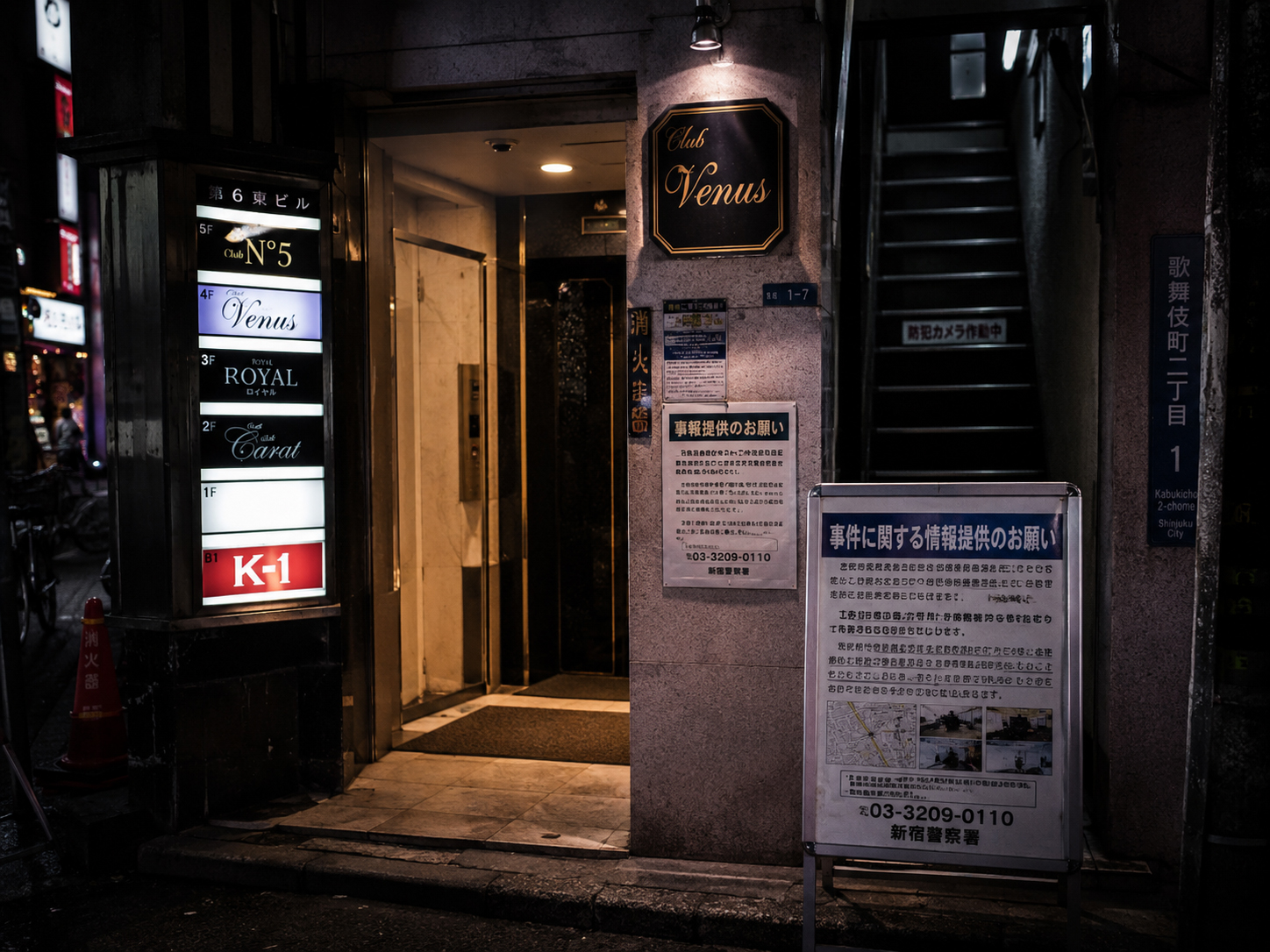
The Tokyo Metropolitan Police Department’s current case page says the wanted suspect, Guo Mingyu, also known as Kwok Mingyu, allegedly conspired with four other men. On August 16, 2001, inside Club Venus in Kabukicho, Shinjuku, he is suspected of stabbing a club employee with a knife, confining customers and hostesses, and robbing them of cash and jewelry.
The story is not simply “crime in a dangerous nightlife district.” For the people inside, Club Venus was a workplace, a night out, a small commercial room in a vertical city of signs, elevators, doors, and money. In one night, that room became a robbery-murder scene and then a file that has remained open for more than two decades.

What the official record says
The MPD record is brief but clear. The incident occurred at Club Venus in Kabukicho. It was not described as a single-person impulsive attack: the wanted man is said to have acted with four other men. A club employee was killed with a knife. Customers and hostesses were confined. Cash and jewelry were stolen. The MPD asks anyone who sees or has seen the wanted man to contact the investigative task force at Shinjuku Police Station.
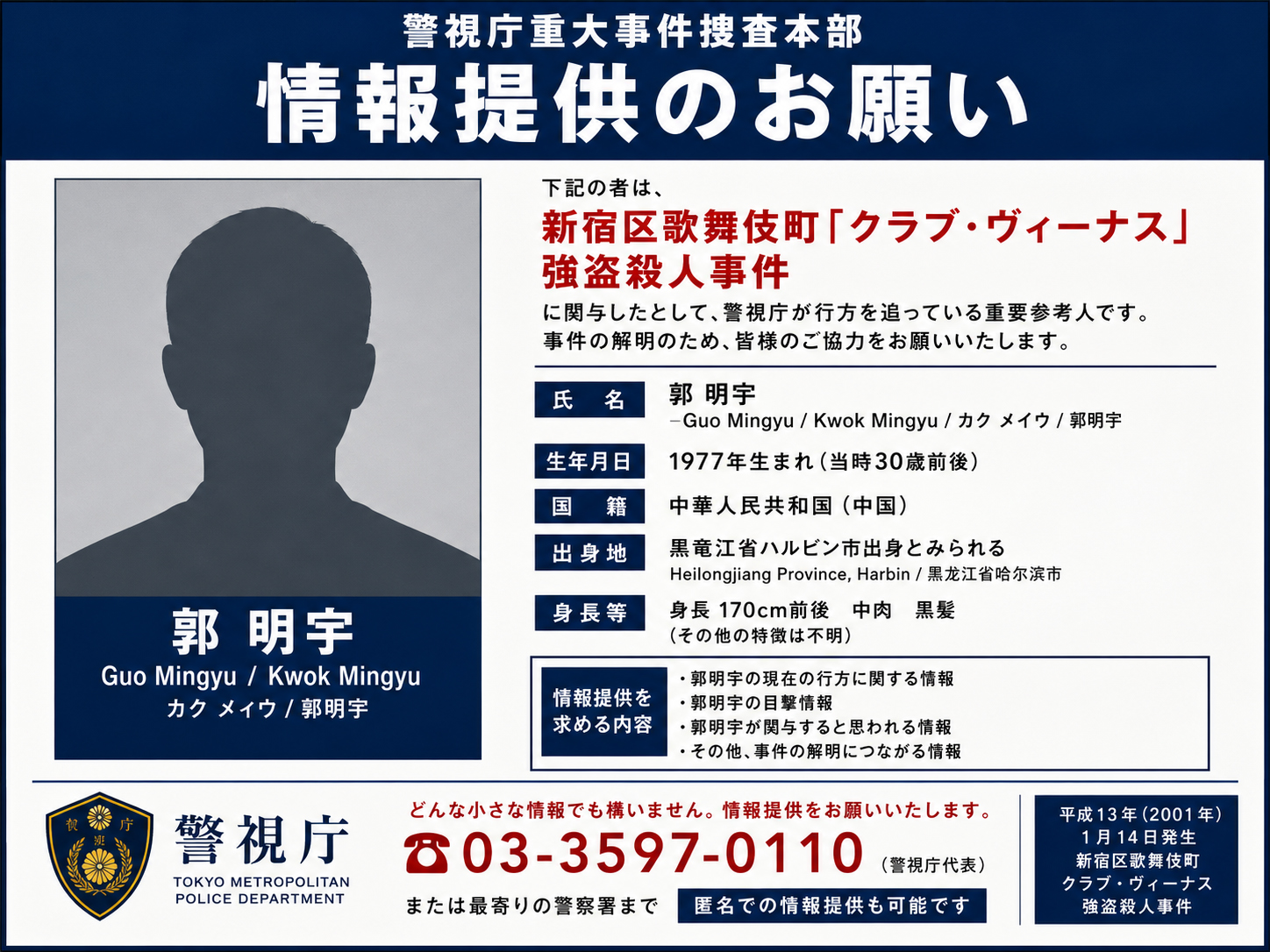
The MPD’s English page lists Guo Mingyu as male, born February 19, 1977, age 24 at the time. Information from 2001 describes him as about 172 centimeters tall, about 66 kilograms, and of medium build. His nationality is listed as the People’s Republic of China, his birthplace as Heilongjiang Province, and his residence history as Harbin, Heilongjiang Province.
The night of August 16, 2001
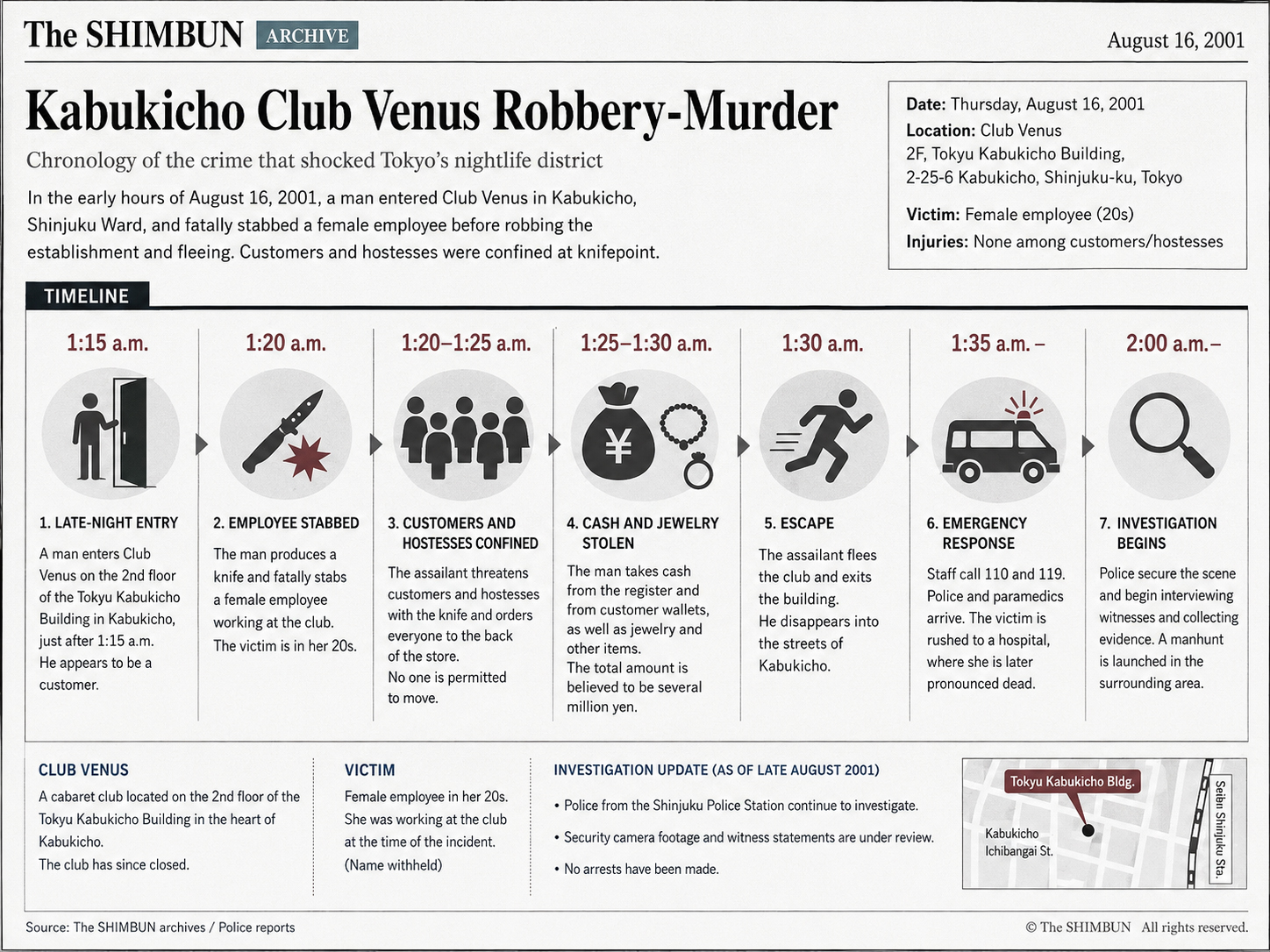
Secondary reporting adds details that should be read separately from the official record. Bunshun Online reported that shortly after 2 a.m., five men entered Club Venus, stabbed the manager in the abdomen, restrained a total of 12 customers and hostesses, stole cash and valuables, and fled. It also reported that the crime became known about an hour later after a customer escaped and contacted authorities.
Those details matter because they show the structure of the crime: entry, control of the room, violence against an employee, immobilization of witnesses, property theft, and escape. They also show how quickly a bright, ordinary commercial space can turn into an evidence map: register, wallets, jewelry, back room, doorway, elevator, stairwell, route out into Kabukicho.
Inside the club
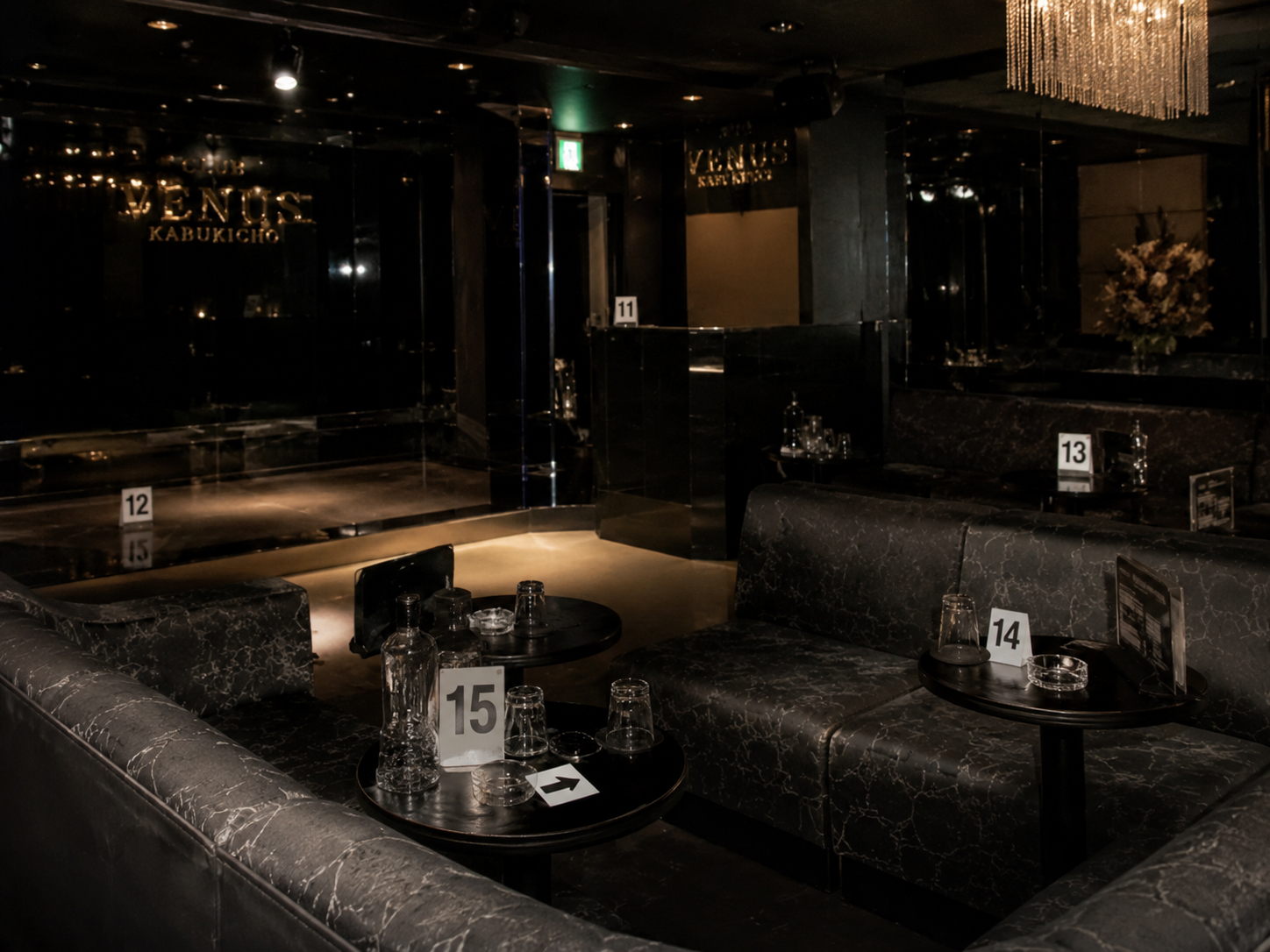
A club interior is a layered space: tables, sofas, counter, hallway, staff area, register, bottles, private rooms, and exits. After the crime, each layer becomes an investigative surface. Witnesses recall who entered, where people were ordered to go, what was taken, which route was used, and whether the offenders spoke, waited, searched, or appeared to know the layout.
Reports say early suspicion focused on people described by witnesses as Chinese, but that kind of general description can distort a case when it is detached from evidence. SHIMBUN treats nationality as an official wanted-person descriptor only when it is tied to a named suspect. The crime belongs to the people who committed it, not to a community.
Cash, jewelry, and a knife
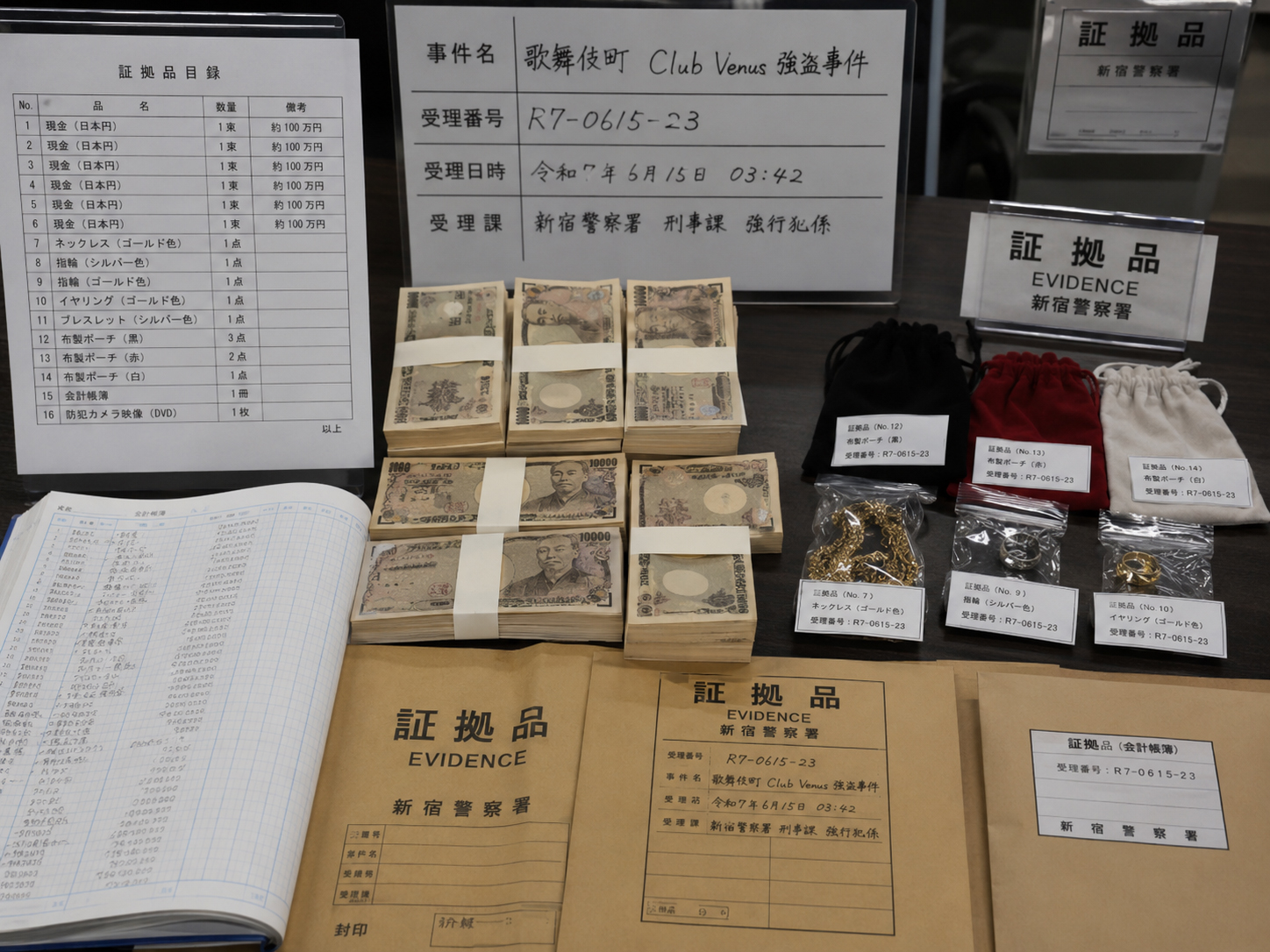
The official record identifies the stolen property as cash and jewelry. In a robbery-murder, property is more than loss value. It can point to motive, division of roles, fence or resale routes, accomplices, money movement, and the possibility that some items were later sold, abandoned, or remembered by someone.
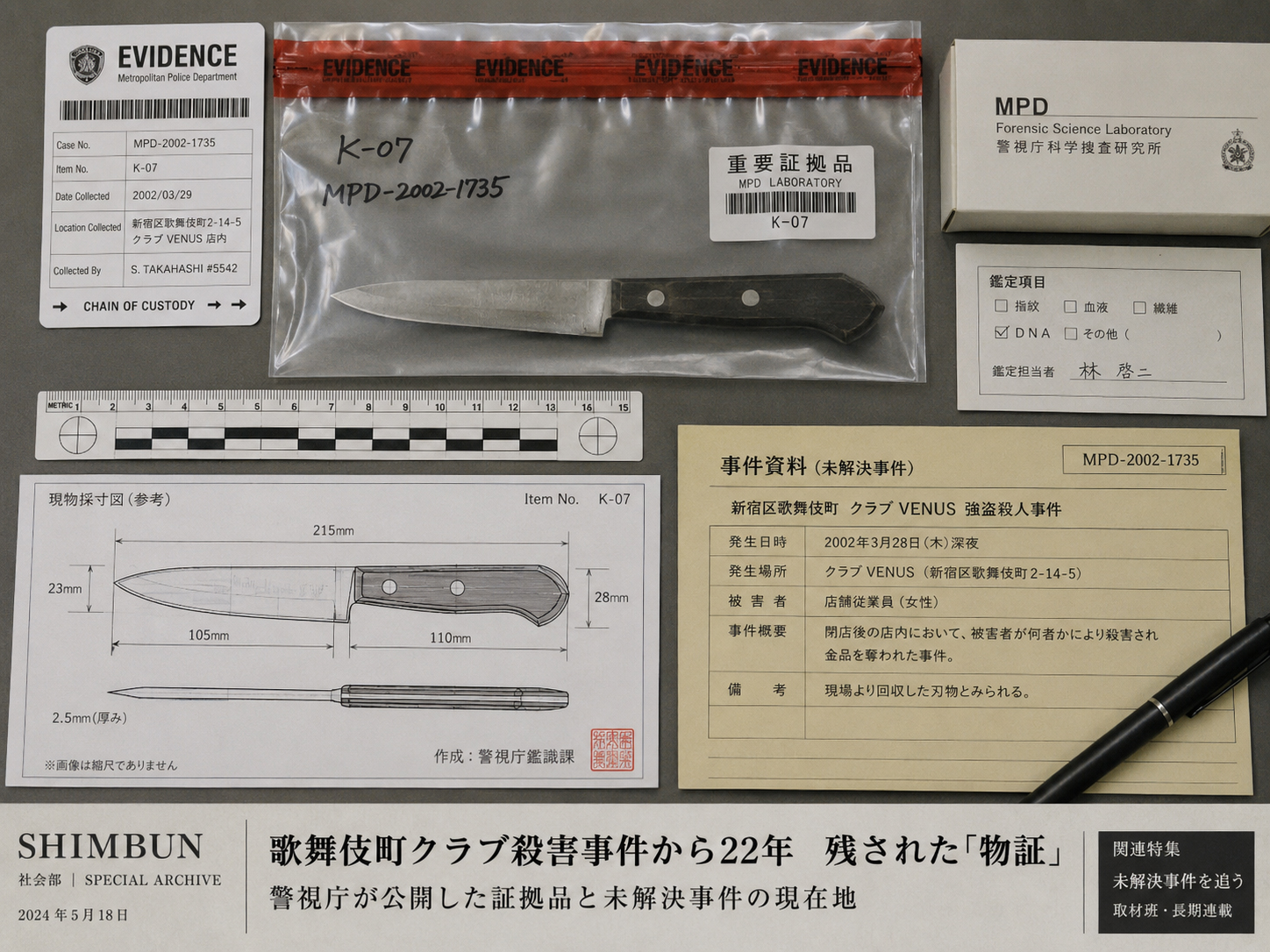
The MPD record says the employee was stabbed with a knife. The weapon should not be treated as a lurid prop. It is physical evidence connected to a death, possible fingerprints or DNA, method of control, and the question of whether the weapon was brought in or obtained on site.
Five men and a wanted suspect
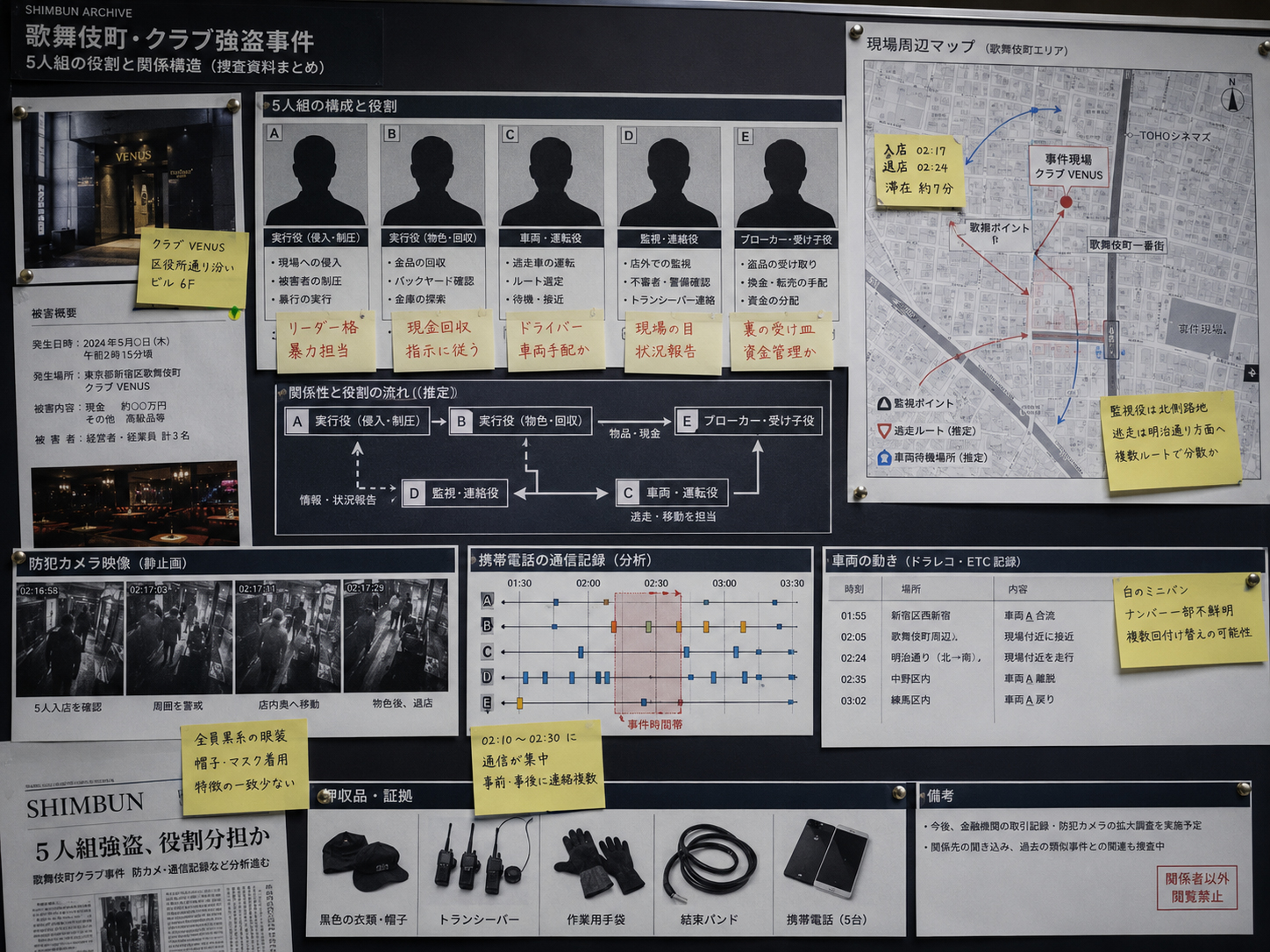
The phrase “with four other men” is central. It means investigators view the case as a coordinated group crime, not merely one person acting alone. A group crime raises questions about roles: who entered first, who used violence, who watched the room, who collected property, who handled escape, who later received or converted stolen items.
Guo Mingyu / Kwok Mingyu remains the public wanted name in the official record. The MPD says sightings or information have been received concerning Beijing and Tianjin. It also says he is thought likely to have left Japan after the crime, but may have reentered and could be hiding domestically. That uncertainty is why small information still matters.
A cross-border file
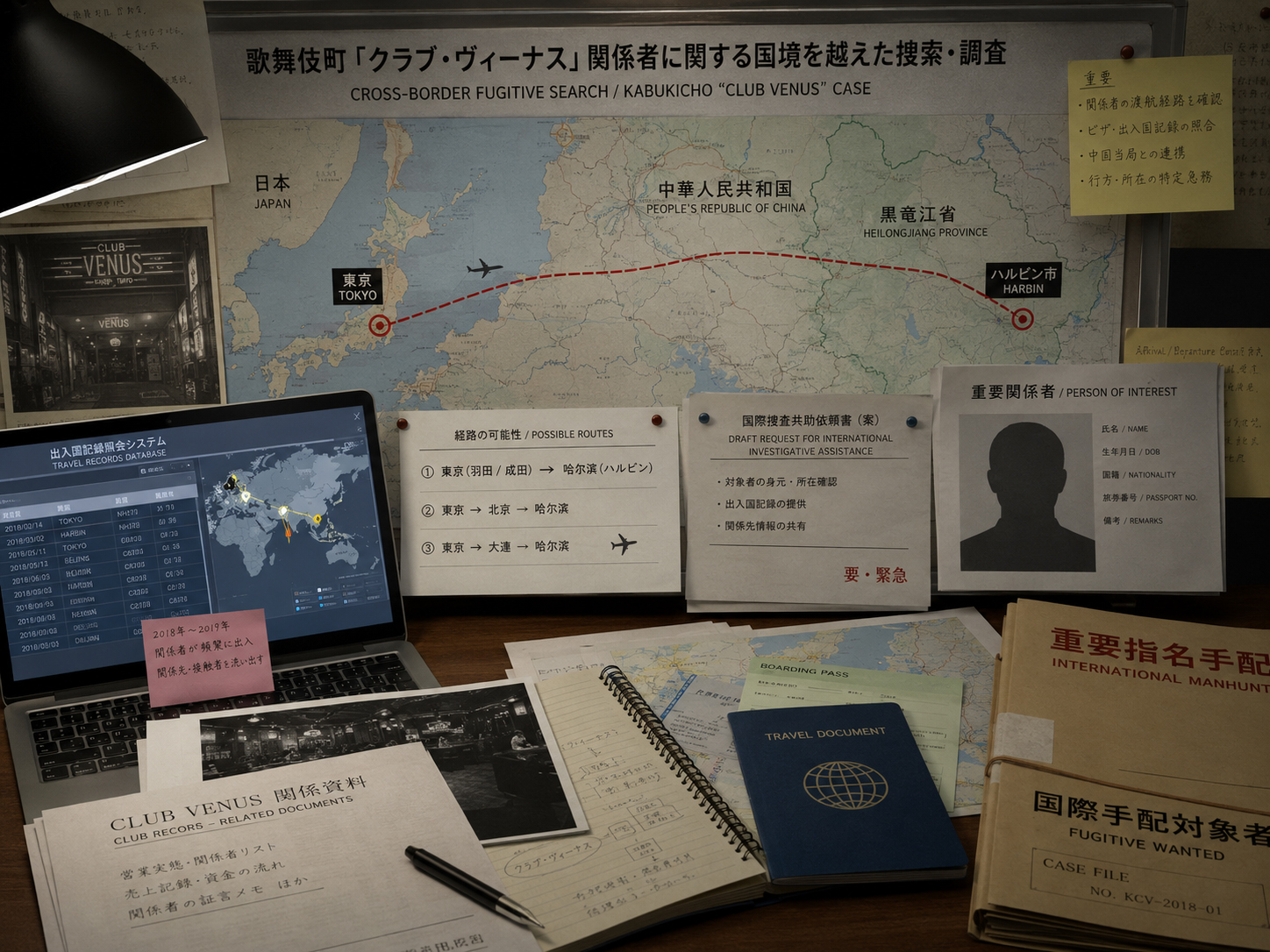
The case began inside a Tokyo club, but the public record now places it in the category of suspected overseas flight. A fugitive search is not only a map line from Tokyo to another city. It involves old identities, travel records, visas, contacts, rumors, returned sightings, and the shrinking but sometimes powerful memories of people who knew the suspect before or after the crime.
The MPD’s public appeal is deliberately broad: have you seen him, do you know his current whereabouts, have you heard rumors about him? In long fugitive cases, a minor memory—a restaurant job, a former address, a phone number, an old conversation—can become the missing bridge.
Kabukicho as context, not excuse
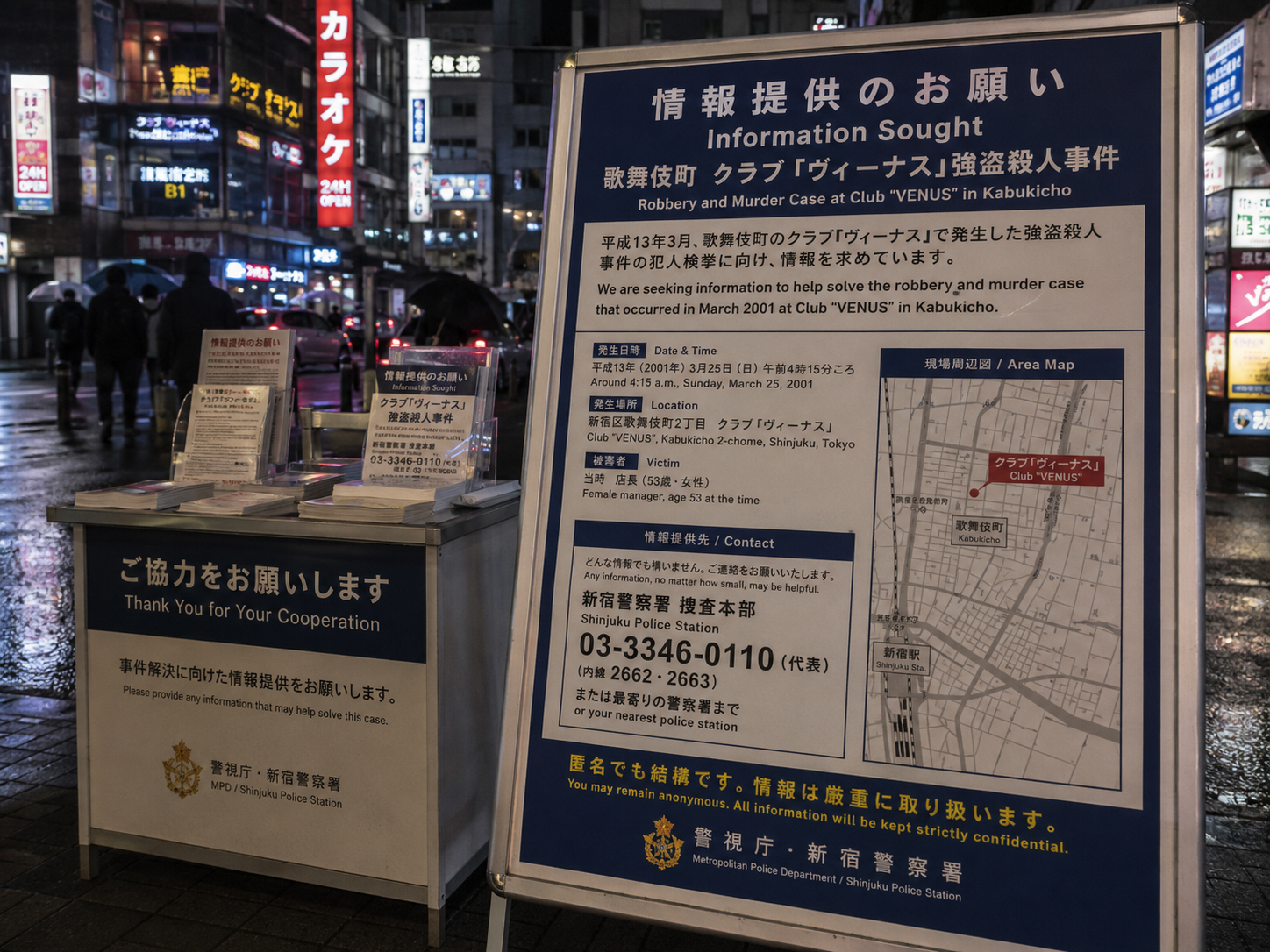
Kabukicho is often described as Tokyo’s bright and dangerous nightlife district. But the district is also a workplace: bar staff, hostesses, cleaners, taxi drivers, restaurant workers, security guards, building managers, police, paramedics, and customers. A victim-centered account should not flatten that world into “the underworld.” It should ask how people working at night are protected, how money moves, how buildings are watched, and how witnesses are heard.
The case also requires care around ethnicity and nationality. Official records identify one wanted person by name and nationality. That is not a license to generalize from one suspect to a community. In SHIMBUN’s framing, the central facts are a killed employee, confined people inside a workplace, stolen cash and jewelry, and a named wanted suspect.
What remains unanswered
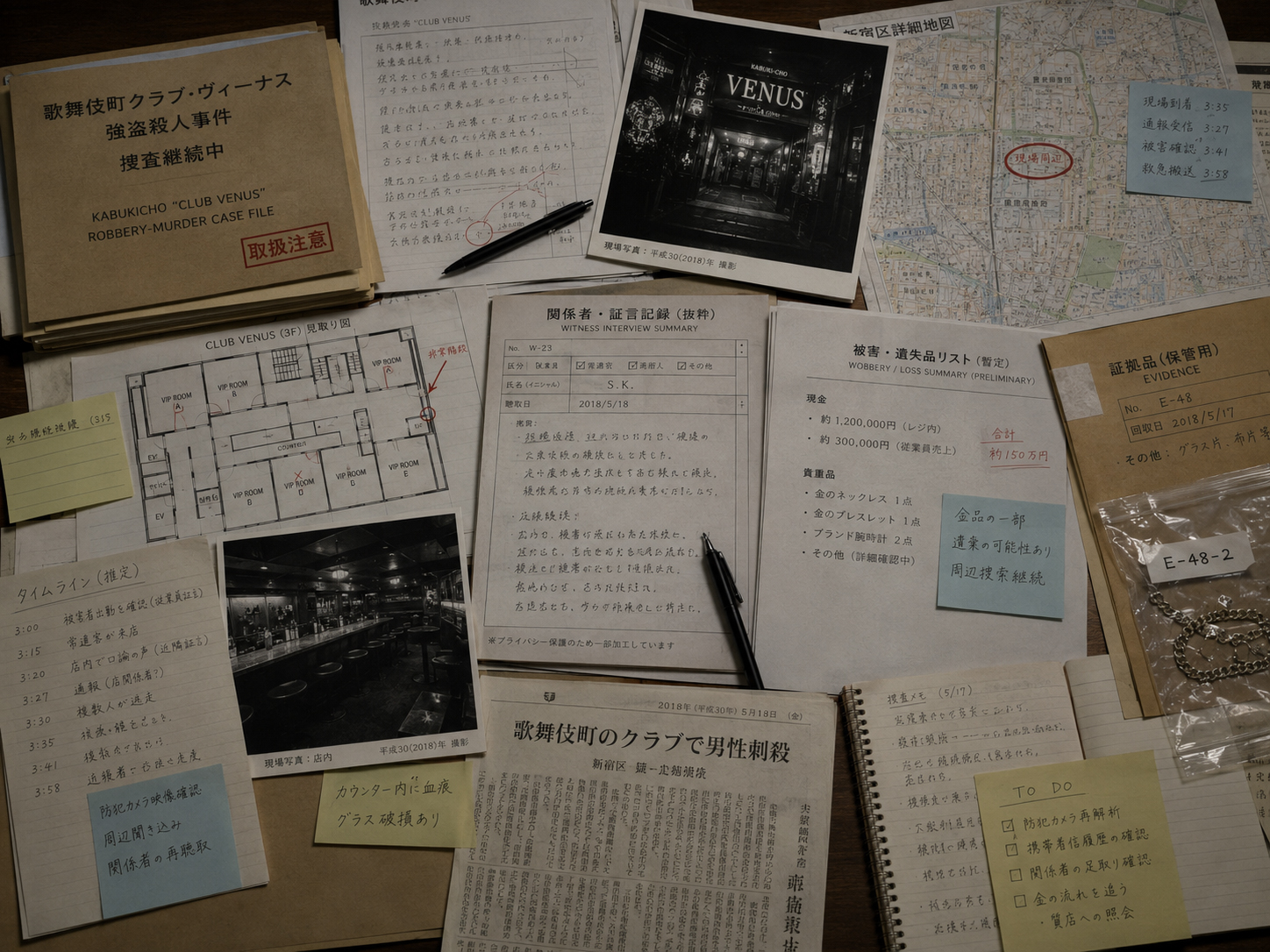
Why was Club Venus targeted? How were the five men connected? Who planned the robbery? Where did the stolen cash and jewelry go? Which evidence tied specific people to specific roles? How reliable were early witness impressions? What happened to Guo Mingyu after the crime? How far did the Beijing and Tianjin sightings go? Could he have reentered Japan?
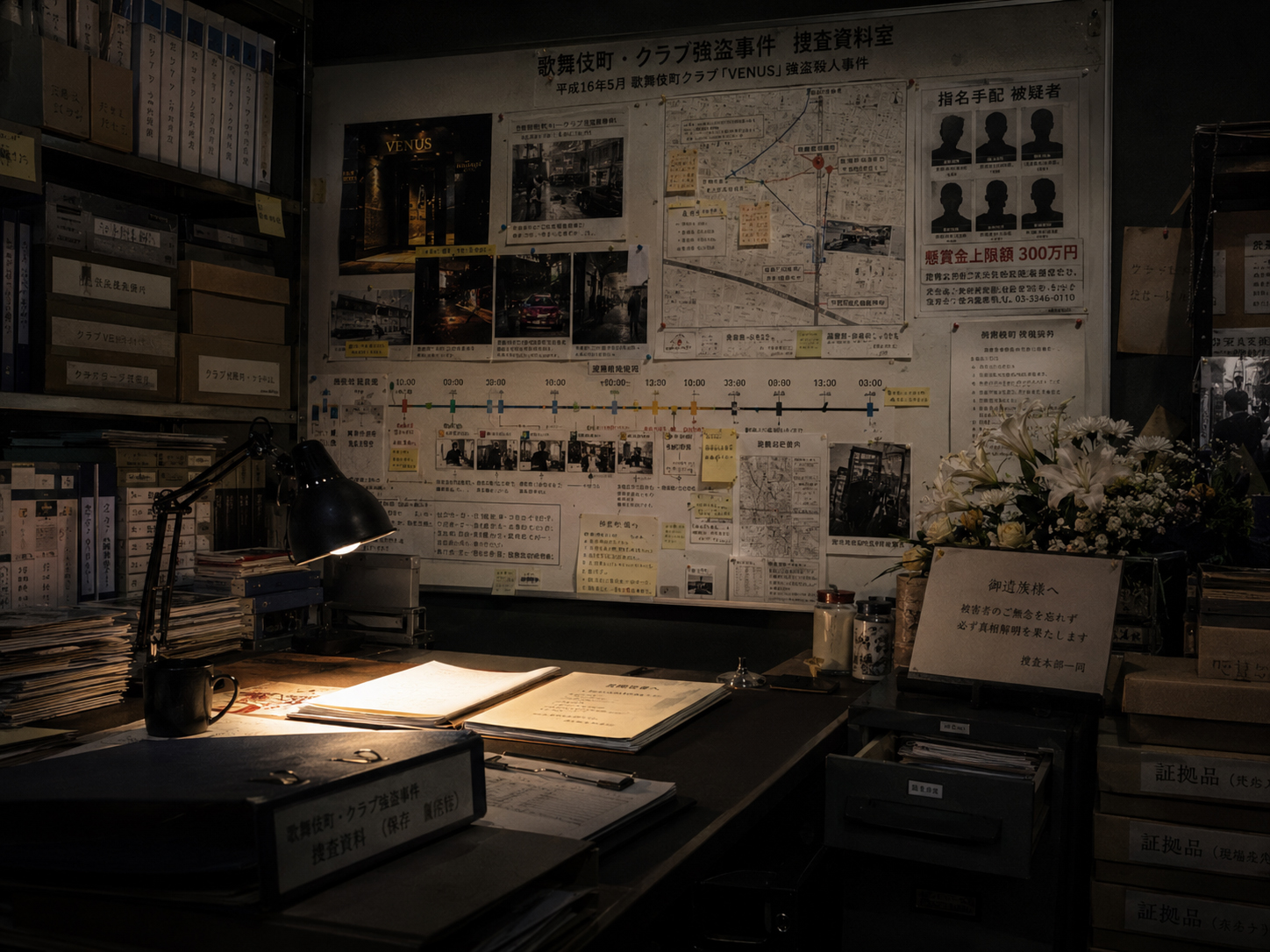
The file remains open because the final line has not been written. The MPD continues to seek information through Shinjuku Police Station. In a case this old, evidence is not only something sealed in a bag. It is also what someone remembers and has not yet said.
Timeline
Image sequence

case-019-kabukicho-club-venus-robbery-murder-hero.jpgHero / Kabukicho nightlife
kabukicho-club-venus-neon-street-2001.jpgKabukicho street context, early 2000s
kabukicho-club-venus-building-entrance.jpgClub Venus building entrance
kabukicho-club-venus-august-16-2001-timeline.jpgTimeline of August 16, 2001
kabukicho-club-venus-inside-club-reconstruction.jpgInterior reconstruction, non-graphic
kabukicho-club-venus-cash-jewelry-evidence.jpgCash and jewelry evidence
kabukicho-club-venus-knife-evidence.jpgKnife evidence reference
kabukicho-club-venus-five-men-conspiracy.jpgFive-man group structure
kabukicho-club-venus-wanted-guo-mingyu.jpgWanted suspect appeal
kabukicho-club-venus-cross-border-search.jpgCross-border search
kabukicho-club-venus-shinjuku-police-appeal.jpgShinjuku Police public appeal
kabukicho-club-venus-investigation-files.jpgInvestigation files
kabukicho-club-venus-cold-case-room.jpgCold-case room
Sources
- Tokyo Metropolitan Police Department English wanted page — official English summary, wanted-person profile, and Shinjuku Police contact.
- Tokyo Metropolitan Police Department Japanese case page — official Japanese case summary, wanted-person details, flight information, and contact point.
- MPD list of suspects who fled overseas — confirms the case’s status on the overseas-fugitive list.
- Bunshun Online, December 12, 2021 — retrospective reporting with investigative-source recollections; treated as secondary reporting, not as the official record.