The core of the case
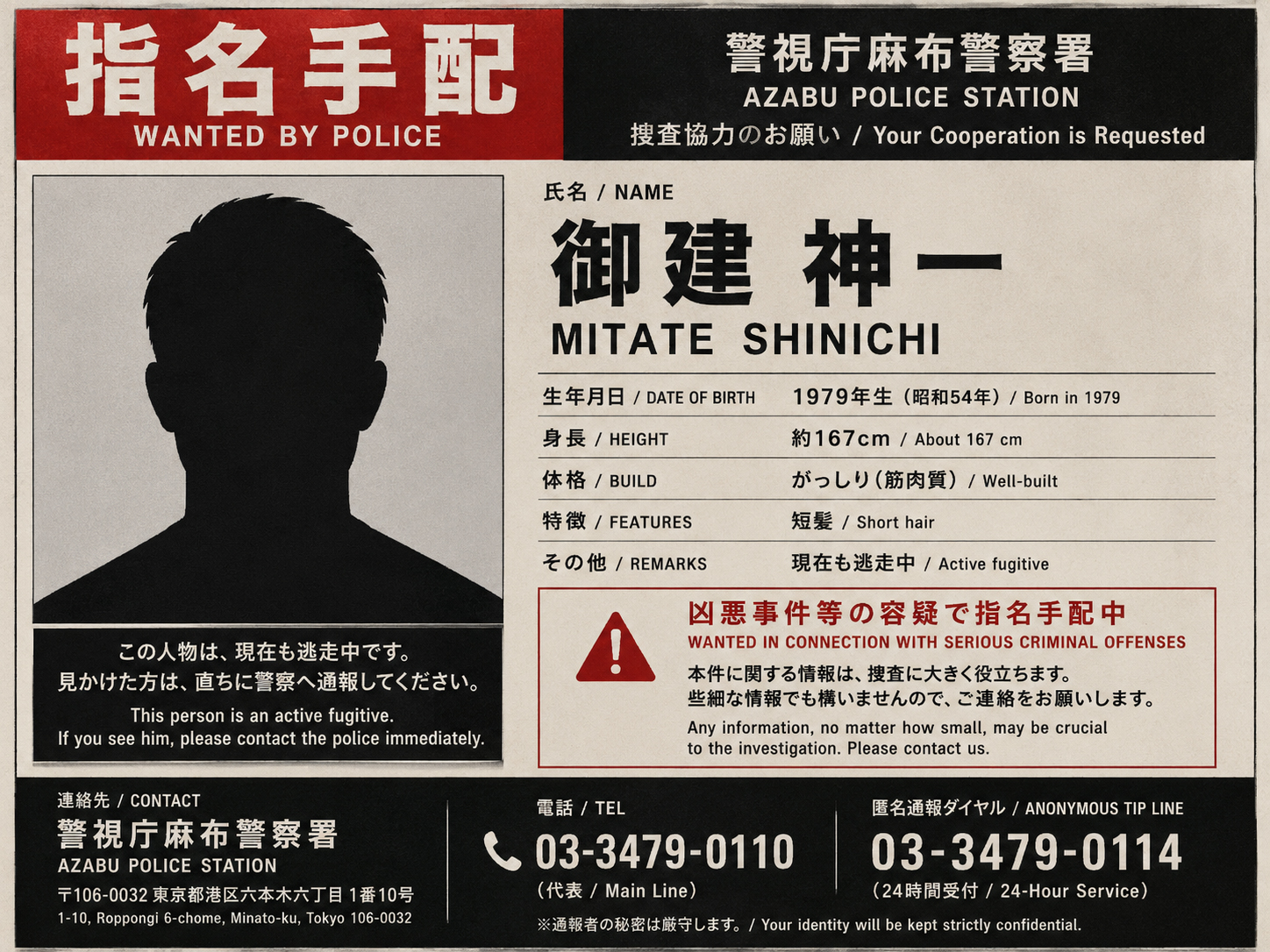
The official Tokyo Metropolitan Police Department page says the wanted man, Mitate Shinichi, is the only alleged ringleader still at large in the murder of a male customer inside Studio Flower, on the second floor of the Loa Roppongi Kyodo Building at 5-1 Roppongi 5-chome, Minato-ku, Tokyo. The attack occurred at around 3:43 a.m. on Sunday, September 2, 2012, and involved multiple assailants using metal bats and other weapons.
The English TMPD wanted page adds the modern tension: Mitate fled abroad soon after the murder, but police say there is also a possibility that he has already returned to Japan and may be hiding in Tokyo, Shizuoka, Saitama, or Miyagi. This is not a sealed historical file. It is a fugitive search that still asks the public for information.
What the official record says
The official record is precise on the spine of the case. The victim was a 31-year-old man. The place was Studio Flower, second floor, in Roppongi 5-chome. The time was before dawn. The attack involved metal bats and other weapons. Police identify Mitate as the alleged ringleader and the only person still at large. The TMPD English page states that all of his accomplices have now been arrested.
Police list Mitate’s features as about 167 cm tall, well-built, short hair, and scars on the left forearm, over the left eye, the frontal region of the head, and the forehead. The National Police Agency’s most-wanted page lists him for murder and unlawful assembly with dangerous weapons, with the Azabu Police Station special investigative team as the contact point.
The before-dawn hour
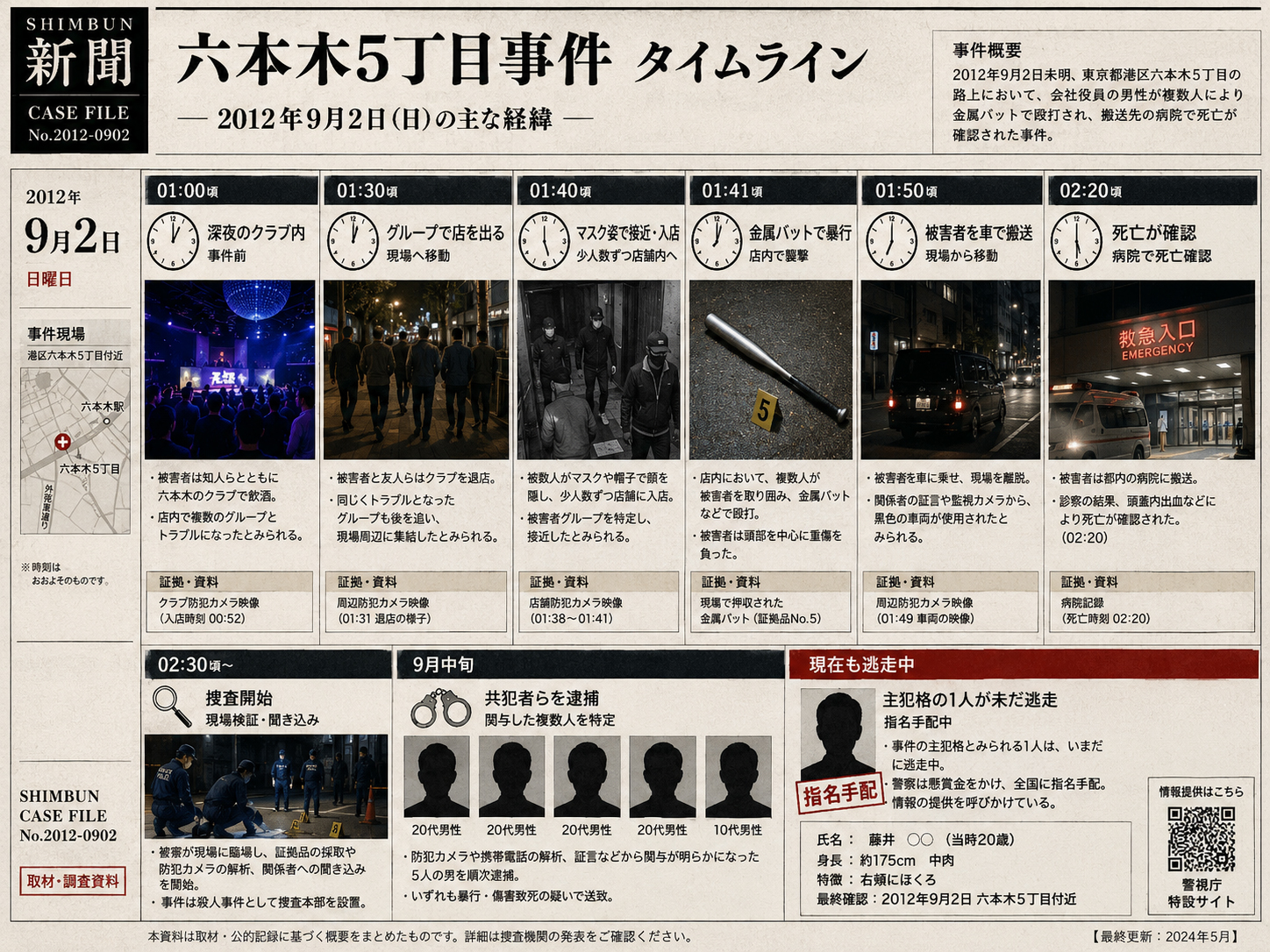
The time matters. At 3:43 a.m., Roppongi was in the strange space between night and morning: clubs still open, taxis moving, workers closing accounts, customers drifting out, and first trains still far away. In that environment, a group could move quickly, strike, and disappear into a district of bright signs and narrow routes.
Secondary reporting has described masked men, a VIP area, CCTV images, and a possible mistaken-identity motive. SHIMBUN treats those details as reporting context, not as the same level of certainty as the official police record. The confirmed center remains this: a male customer was killed inside a Roppongi 5-chome nightclub; police allege Mitate was the ringleader; he has not been arrested.
Studio Flower: entrance, interior, route
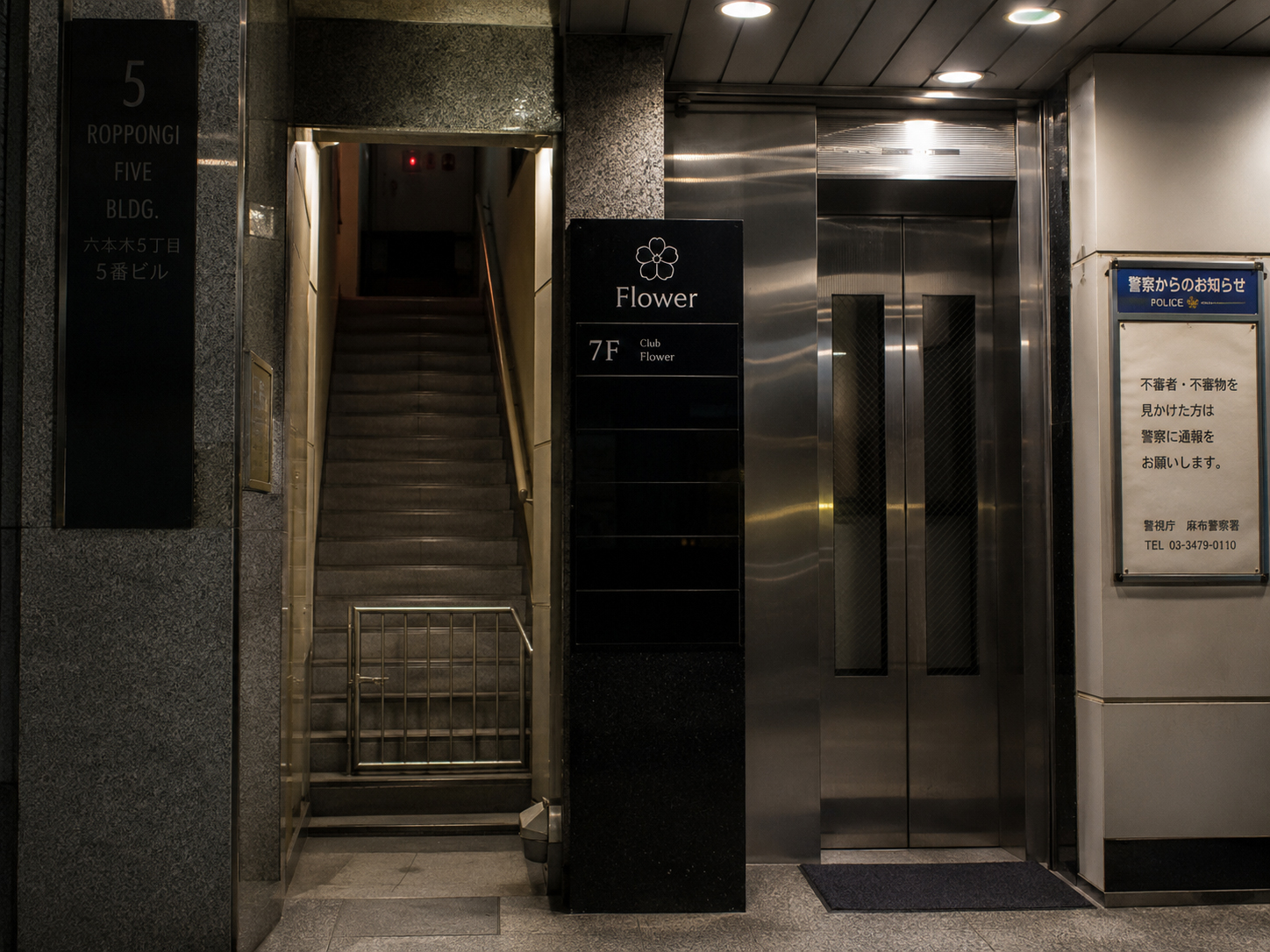
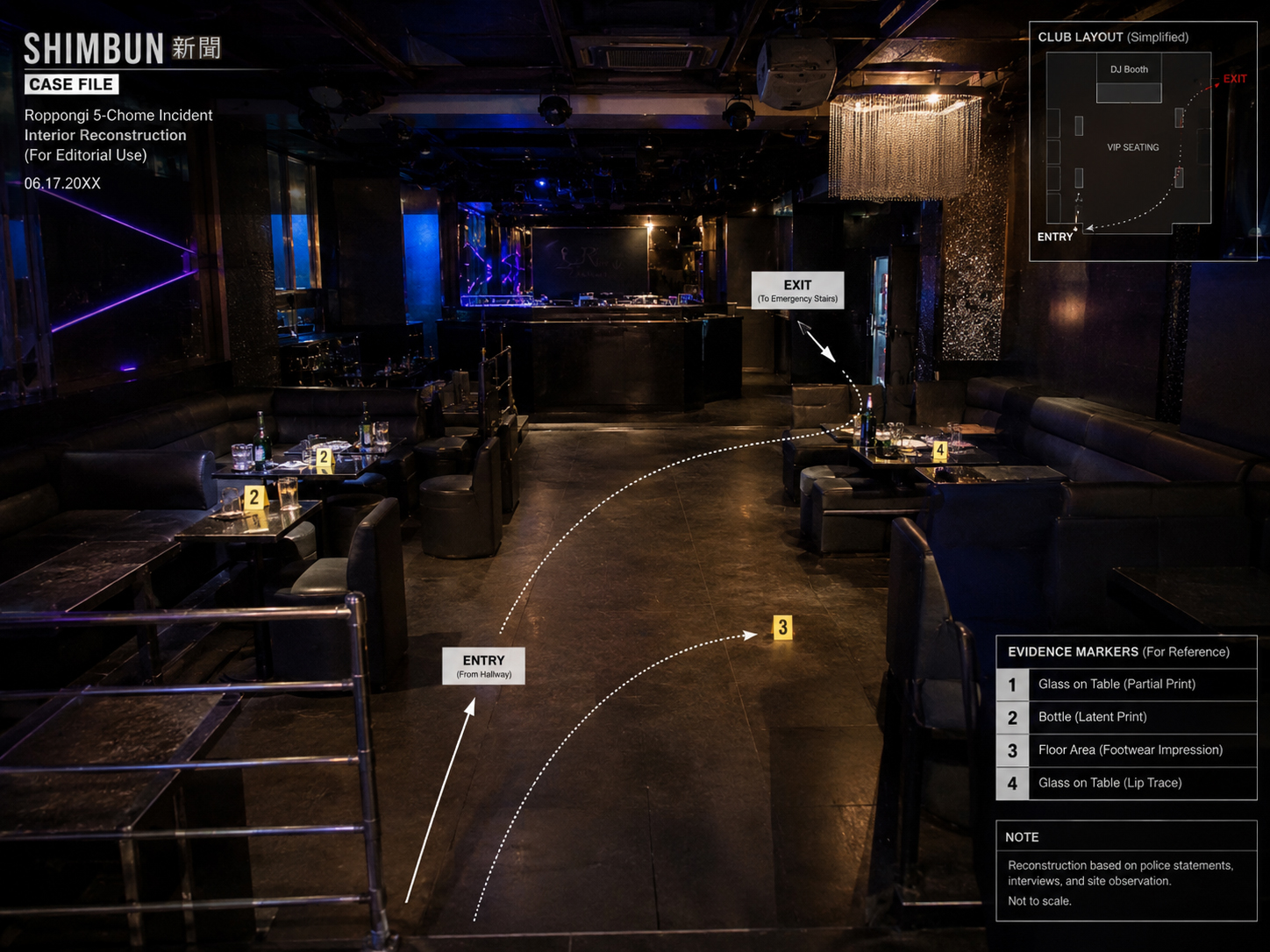
In a nightlife case, architecture becomes evidence. A front entrance, a rear entrance, stairs, elevators, emergency doors, VIP seating, cameras, and blind spots all shape what can be reconstructed. A “nightclub murder” is not only an act of violence. It is also a movement problem: how did the group approach, enter, attack, leave, and disperse?
The TMPD page places the case inside Studio Flower. Reporting has discussed an interior route and masked movement. The page’s images therefore focus on structure rather than spectacle: the building access, the non-graphic club reconstruction, and the route logic that investigators would have needed to understand.
Metal bats, CCTV, and group movement
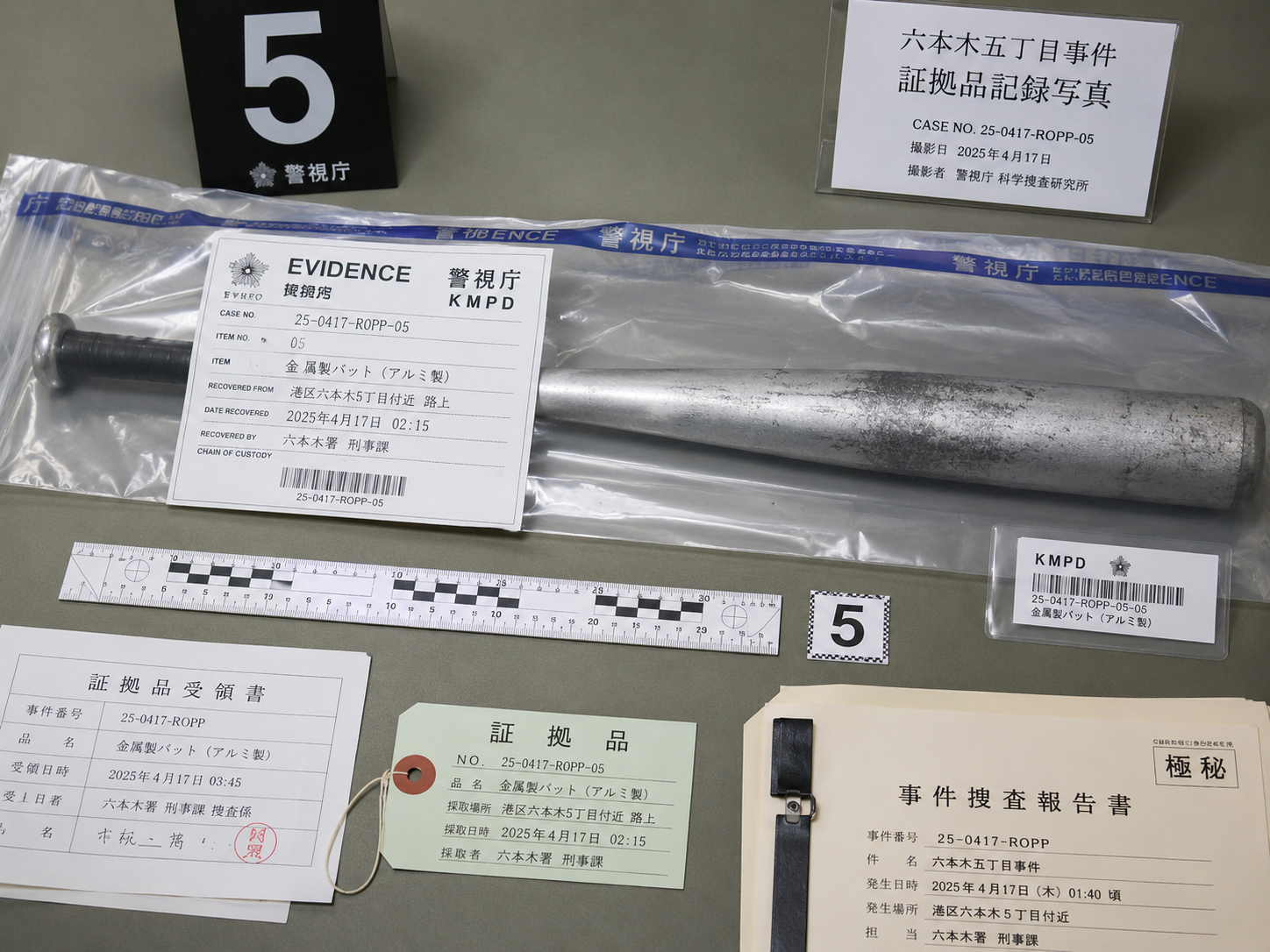
The official police pages identify metal bats and other weapons. The object is brutal, but the visual treatment should be clinical. A metal bat is not a prop. It is physical evidence: something to measure, photograph, test, trace, and connect to witness accounts and video.
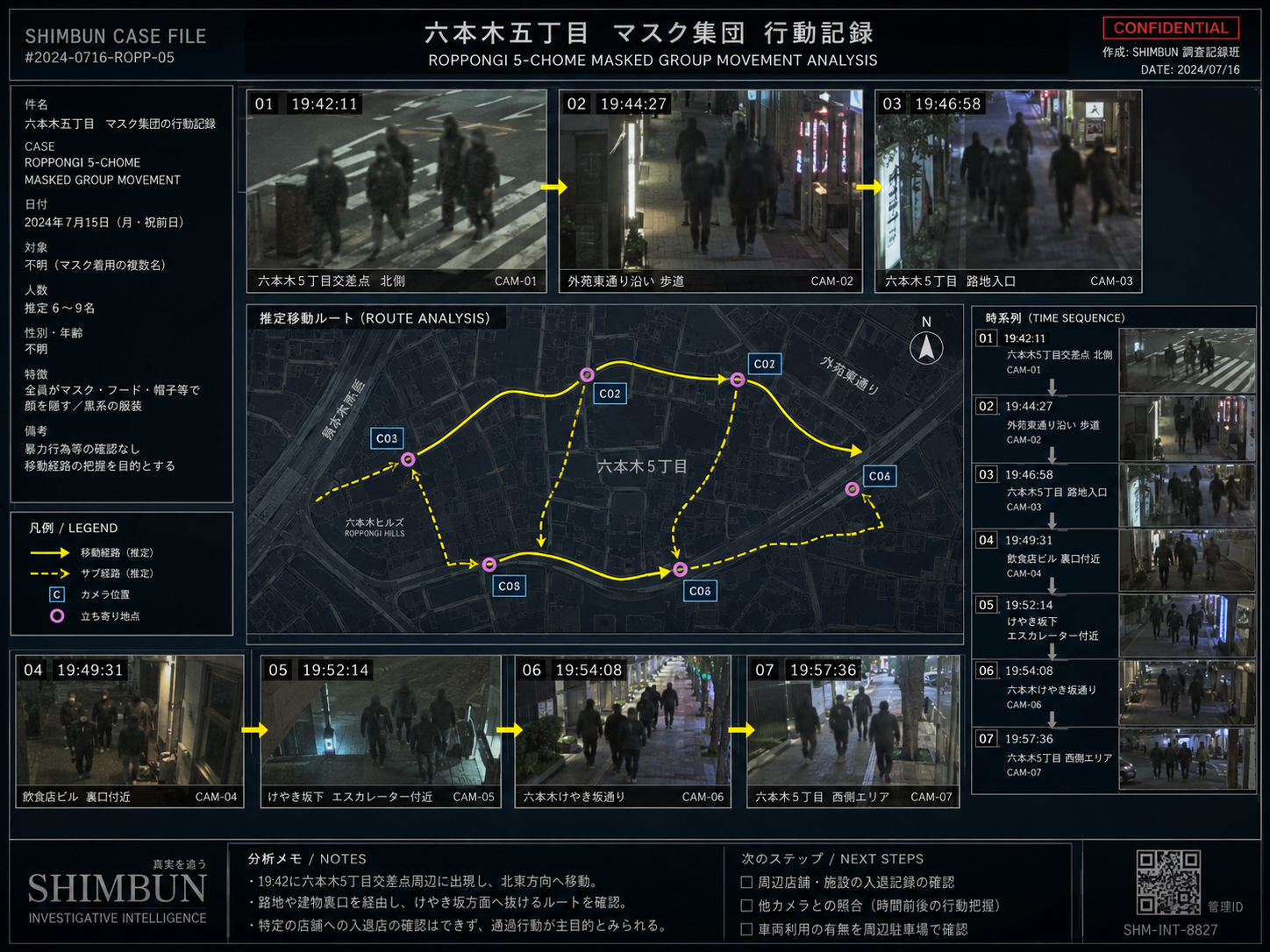
Surveillance is equally important. Roppongi’s streets and clubs are full of cameras, but night, masks, crowding, and route complexity all create gaps. CCTV may not identify a face, yet it can still reveal number, timing, clothing, direction, and vehicle association. Those details build or break a case.
Returning to the victim
High-profile fugitive cases can become stories about the fugitive. This page must resist that. The center is the man who died at age 31. Officially, he is listed as a male victim, then 31. Secondary reporting has identified him as Ryosuke Fujimoto and described him as connected to the restaurant/bar world. However named, he was not a symbol. He was a person whose life ended in a place of nightlife and work.
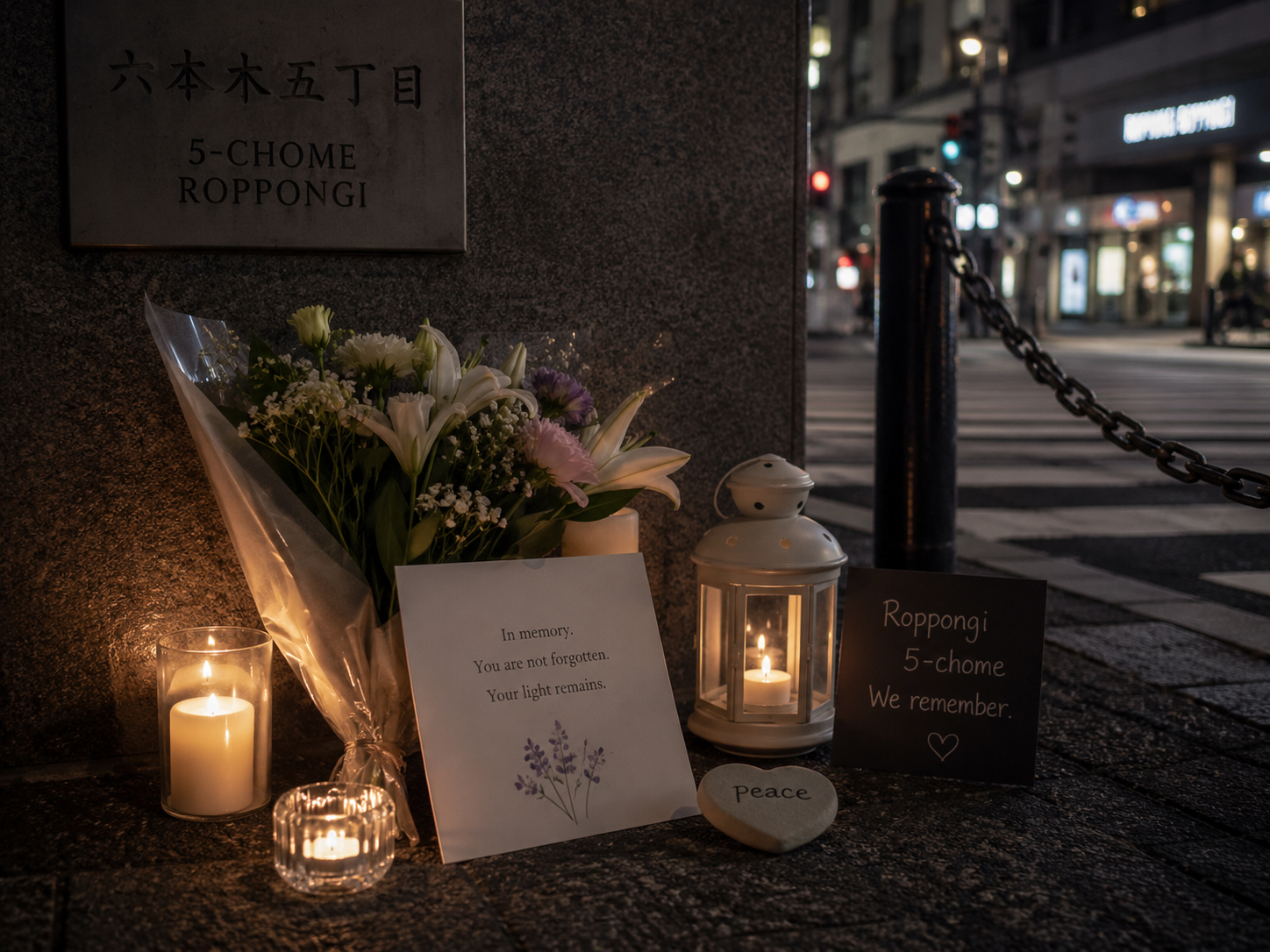
The simplest image in this file is also the most important: flowers at Roppongi 5-chome. It interrupts the wanted posters and gang context. It says that the story is not about outlaw charisma. It is about a life taken and a family left with the consequence.
Kantō Rengō, hangure, and the danger of myth
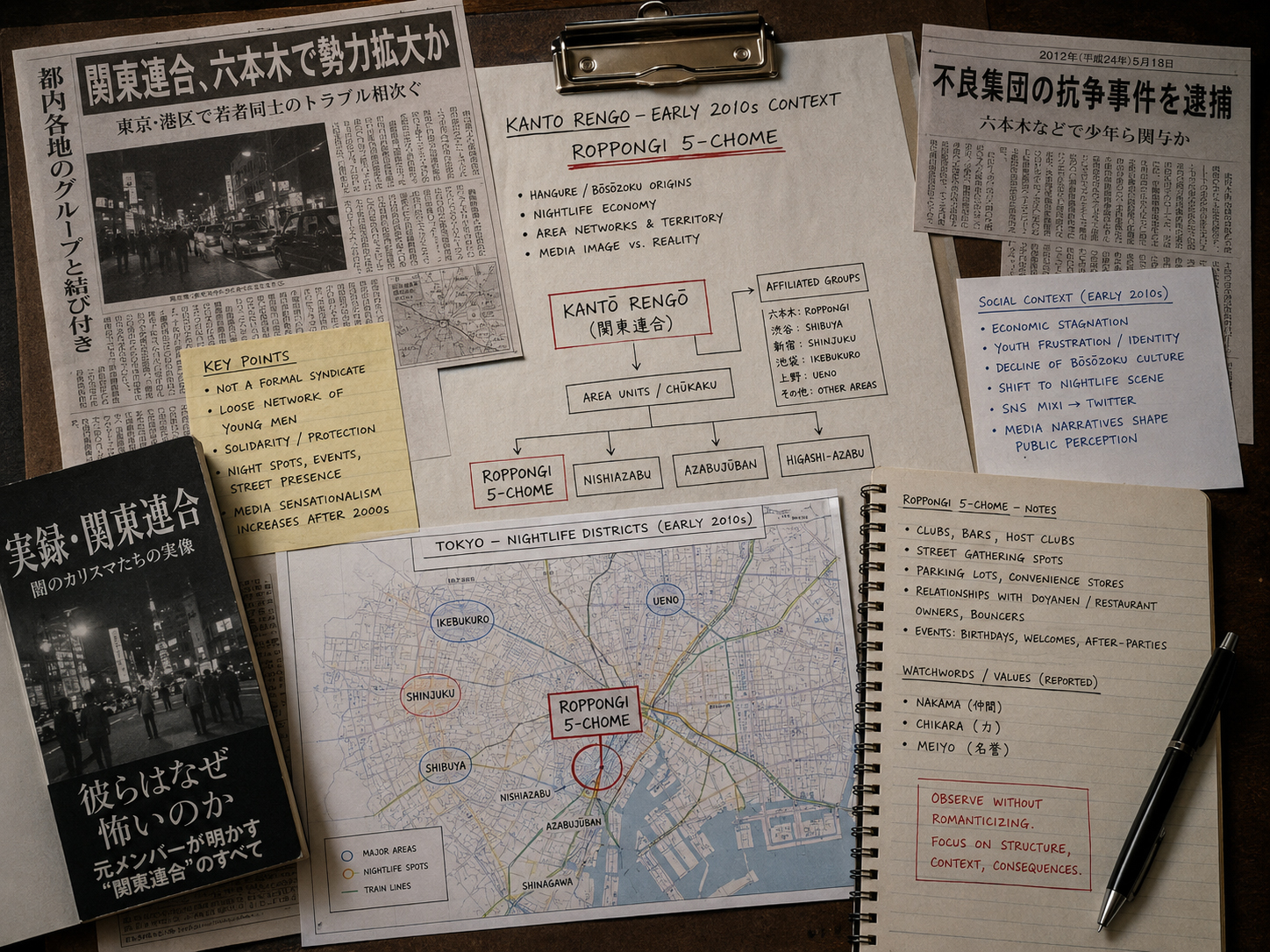
Commentary and reporting often connect the case to Kantō Rengō and Japan’s broader hangure phenomenon: loose criminal networks outside the traditional yakuza structure. Nippon.com’s interview on hangure violence describes Kantō Rengō as a former bōsōzoku-linked network without the same pseudo-family hierarchy as established yakuza groups, and discusses Mitate’s alleged role within that context.
That context matters. But it can also distort. The page should not turn the case into gang mythology. The better question is structural: how a loose network, nightlife economy, old rivalries, social media-era visibility, and fast group mobilization could produce a public killing in a commercial space.
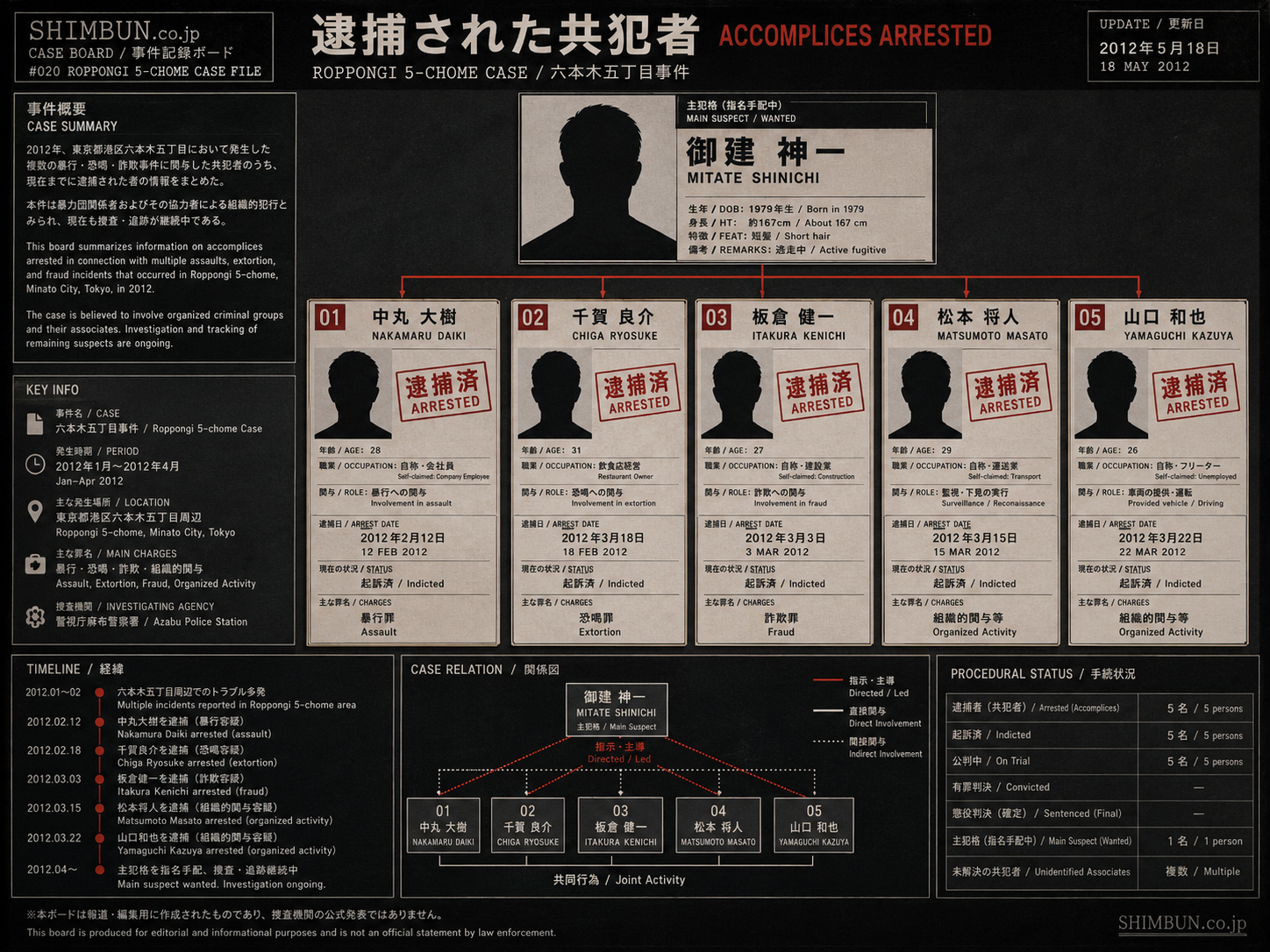
Arrested accomplices, one remaining fugitive
The official English TMPD page states that all accomplices have now been arrested. That line matters because it isolates the unresolved part of the file. The group case moved through arrests and courts. The active case remains Mitate.
In the public memory of a case, arrests can create the false impression of closure. But when the alleged ringleader is still wanted, the file stays open. For investigators, the unfinished part is not abstract. It is a name, a profile, old associates, possible supporters, possible hiding places, and the hope that someone still remembers something useful.
Two search lines: overseas and inside Japan
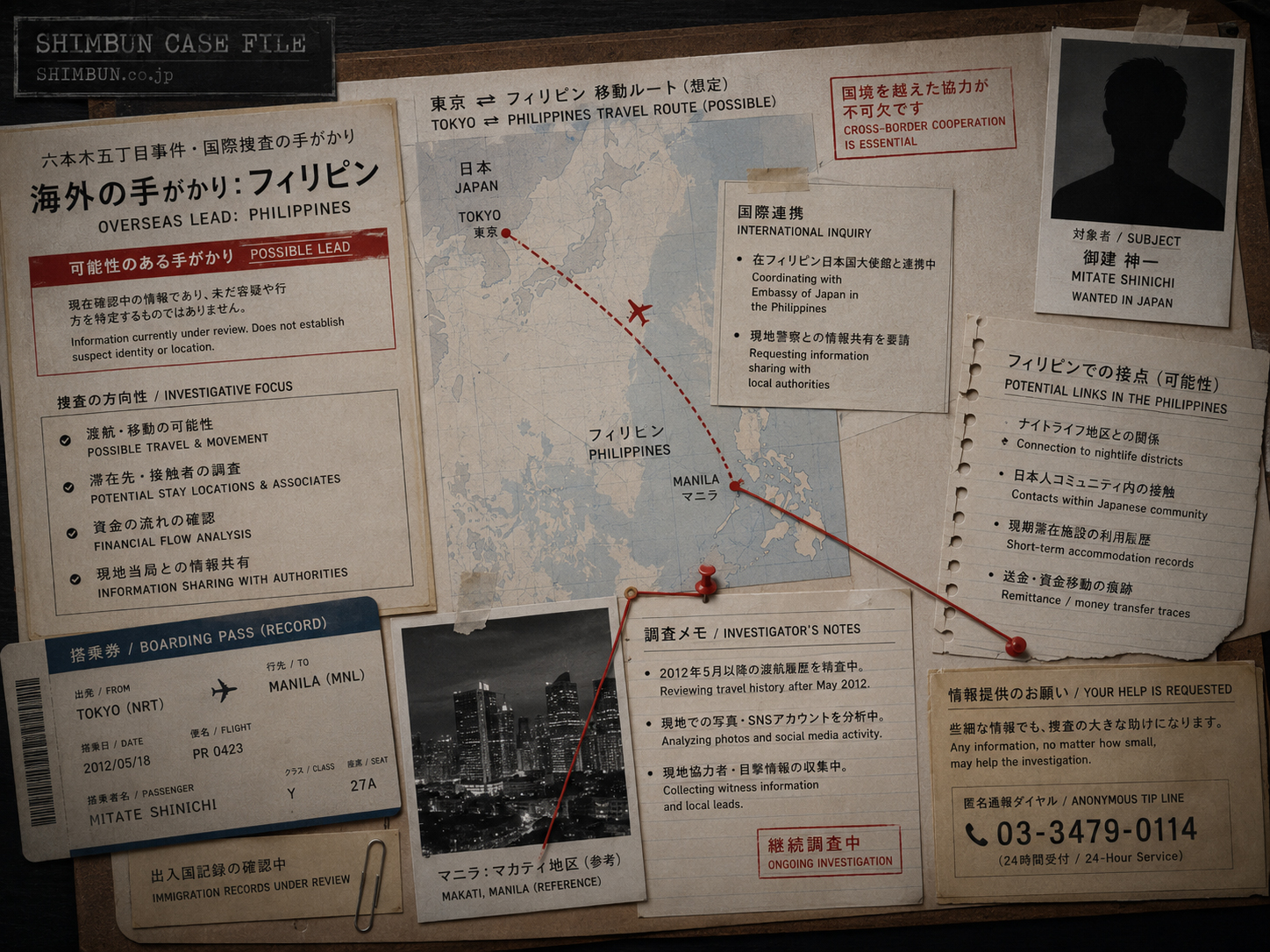
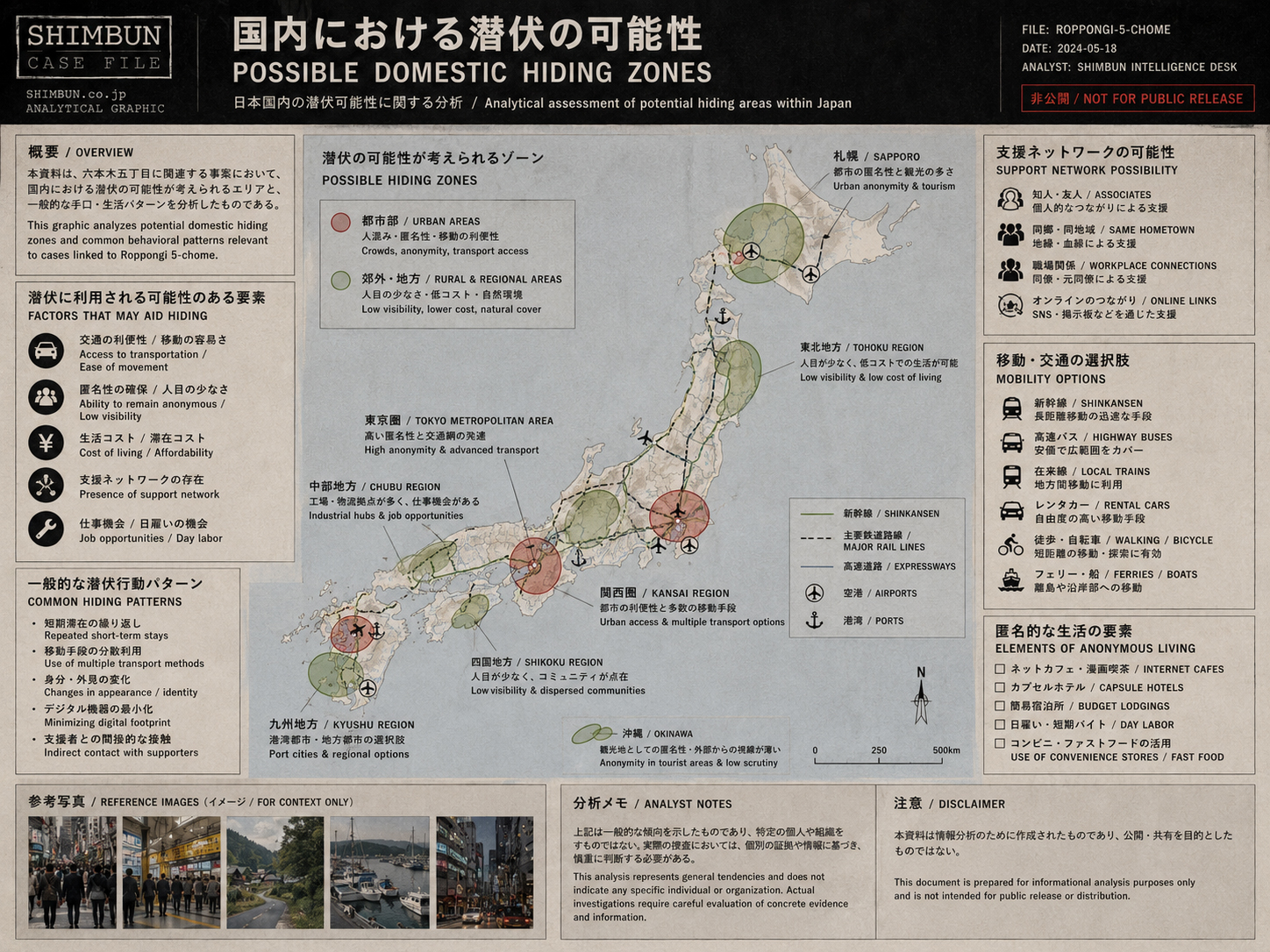
The official police language preserves both possibilities: Mitate fled abroad soon after the murder, but he may have returned to Japan. TMPD lists possible domestic hiding places in Tokyo, Shizuoka, Saitama, and Miyagi. That is the official lead structure.
Media reporting has frequently focused on the Philippines, including accounts that investigators believed Mitate entered the country after the killing. More recent reporting has discussed other overseas rumors. SHIMBUN treats these as reported leads, not confirmed location. In an active fugitive file, rumor and fact must not be mixed. Bad information can bury good information.
The ¥6 million reward and the public appeal
The TMPD page lists a reward structure: up to ¥3 million from the NPA Commissioner General’s special reward program, plus up to ¥3 million from the Association for Cooperation with the Investigation of Murder in a Nightclub in Roppongi 5-chome. The information period currently listed is November 1, 2025 through October 31, 2026.
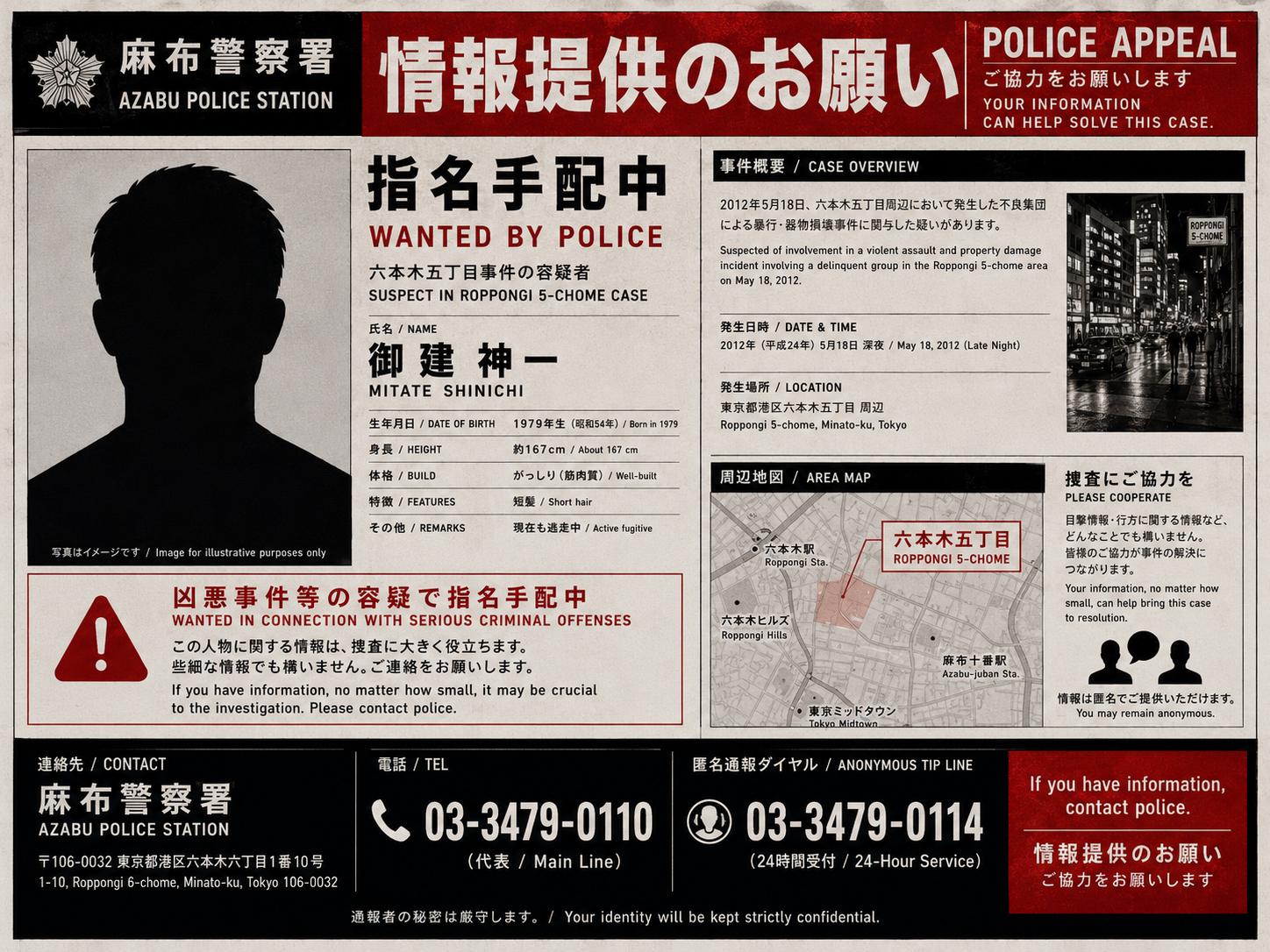
The requested information is broad: someone who looks like the wanted man, someone who aided his escape, current whereabouts, or places he frequents. “Any little piece of information” is not a cliché here. In a long fugitive case, a small remembered fact can be the first real movement in years.
A season closer that is not closed
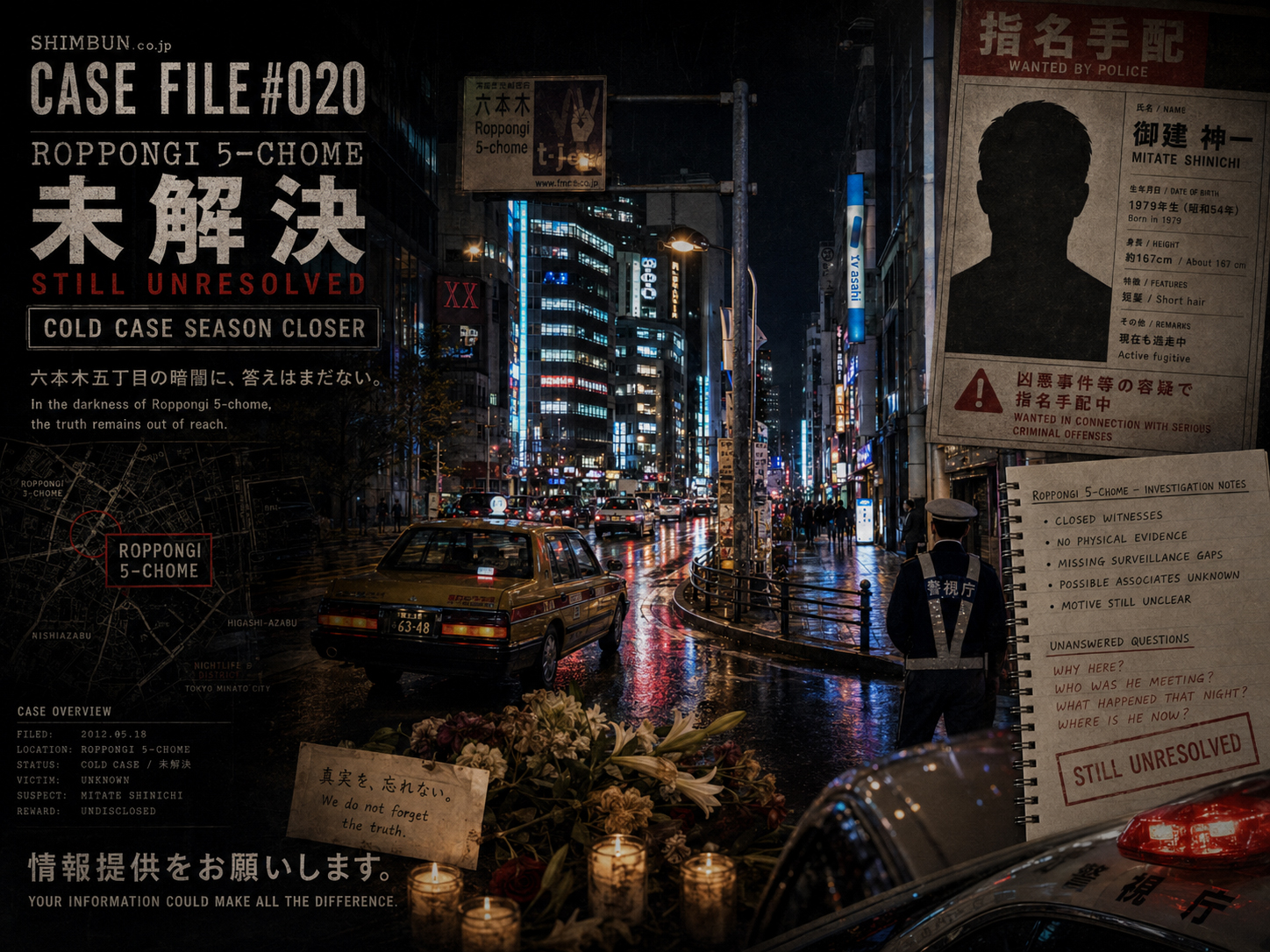
Case File 020 closes a season of unsolved Japanese cases, but it does not close the story. The city changed. Clubs closed or renamed. Witnesses aged. Digital traces decayed. Yet the official wanted page remains live, the reward period remains current, and the public is still asked to help.
Roppongi 5-chome is a place of lights. This file is about the darkness those lights could not erase: a man killed, accomplices arrested, an alleged ringleader gone, and the possibility that someone, somewhere, knows where he went.
Timeline
Image sequence
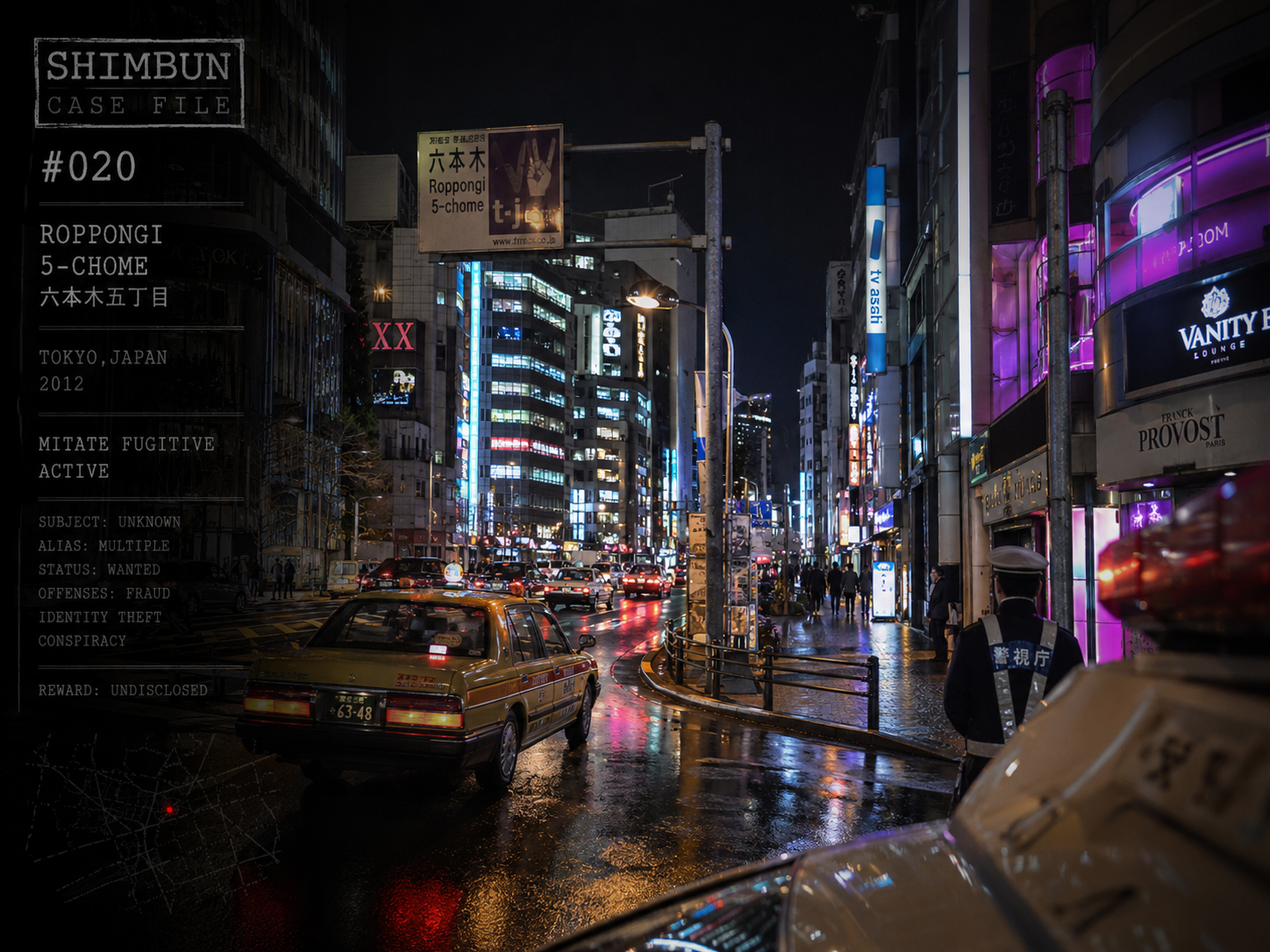
case-020-roppongi-5-chome-mitate-fugitive-hero.jpgHero / active fugitive season closer — Roppongi 5-chome at night, wet pavement, police presence and unresolved case-file tone.
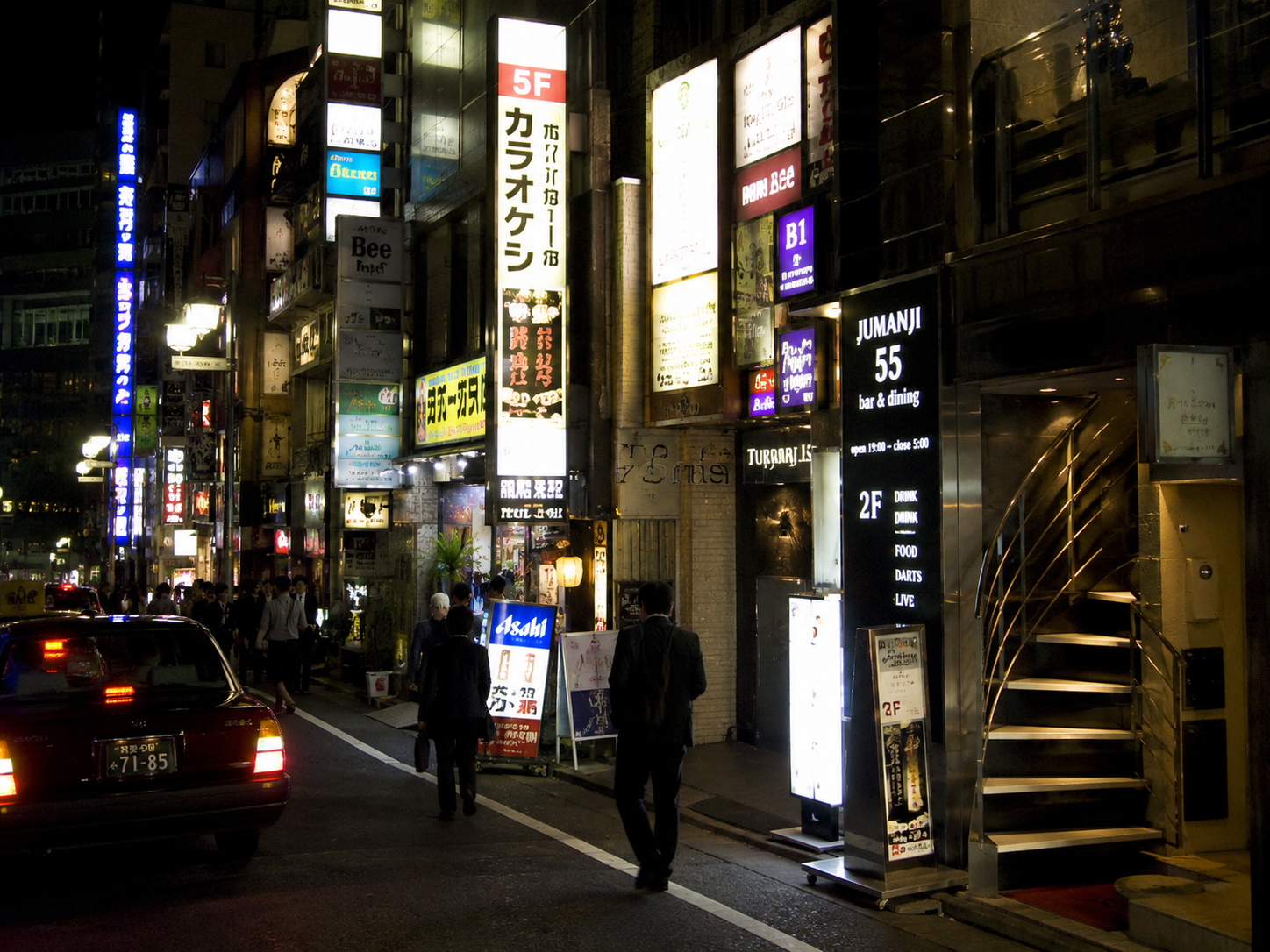
roppongi-5-chome-nightclub-street-2012.jpgPlace and era — Early-2010s Roppongi nightlife street context.
roppongi-5-chome-club-flower-entrance.jpgClub Flower entrance — Building entrance and access context, not a reenactment.
roppongi-5-chome-september-2-2012-timeline.jpgTimeline — September 2, 2012 chronology visual.
roppongi-5-chome-inside-club-reconstruction.jpgInterior reconstruction — Non-graphic reconstruction of the club interior and routes.
roppongi-5-chome-metal-bat-evidence.jpgMetal bat evidence — Clinical evidence-file visual for the alleged weapon.
roppongi-5-chome-masked-group-cctv.jpgCCTV / movement — Surveillance-style group movement analysis.
roppongi-5-chome-victim-memory.jpgVictim memory — Flowers and candles for the victim-centered pause.
roppongi-5-chome-mitate-wanted-poster.jpgMitate wanted poster — Official-style wanted appeal using a silhouette.
roppongi-5-chome-kanto-rengo-context.jpgKantō Rengō context — Analytical context board, not gang mythology.
roppongi-5-chome-accomplices-arrested-board.jpgAccomplices arrested — Case-status board: accomplices arrested, alleged ringleader still wanted.
roppongi-5-chome-philippines-lead.jpgPhilippines lead — Overseas lead and cross-border search context.
roppongi-5-chome-japan-hiding-possibilities.jpgDomestic hiding possibilities — Possible Japan hiding areas listed by police, treated cautiously.
roppongi-5-chome-azabu-police-appeal.jpgAzabu Police appeal — Public tip appeal and contact visual.
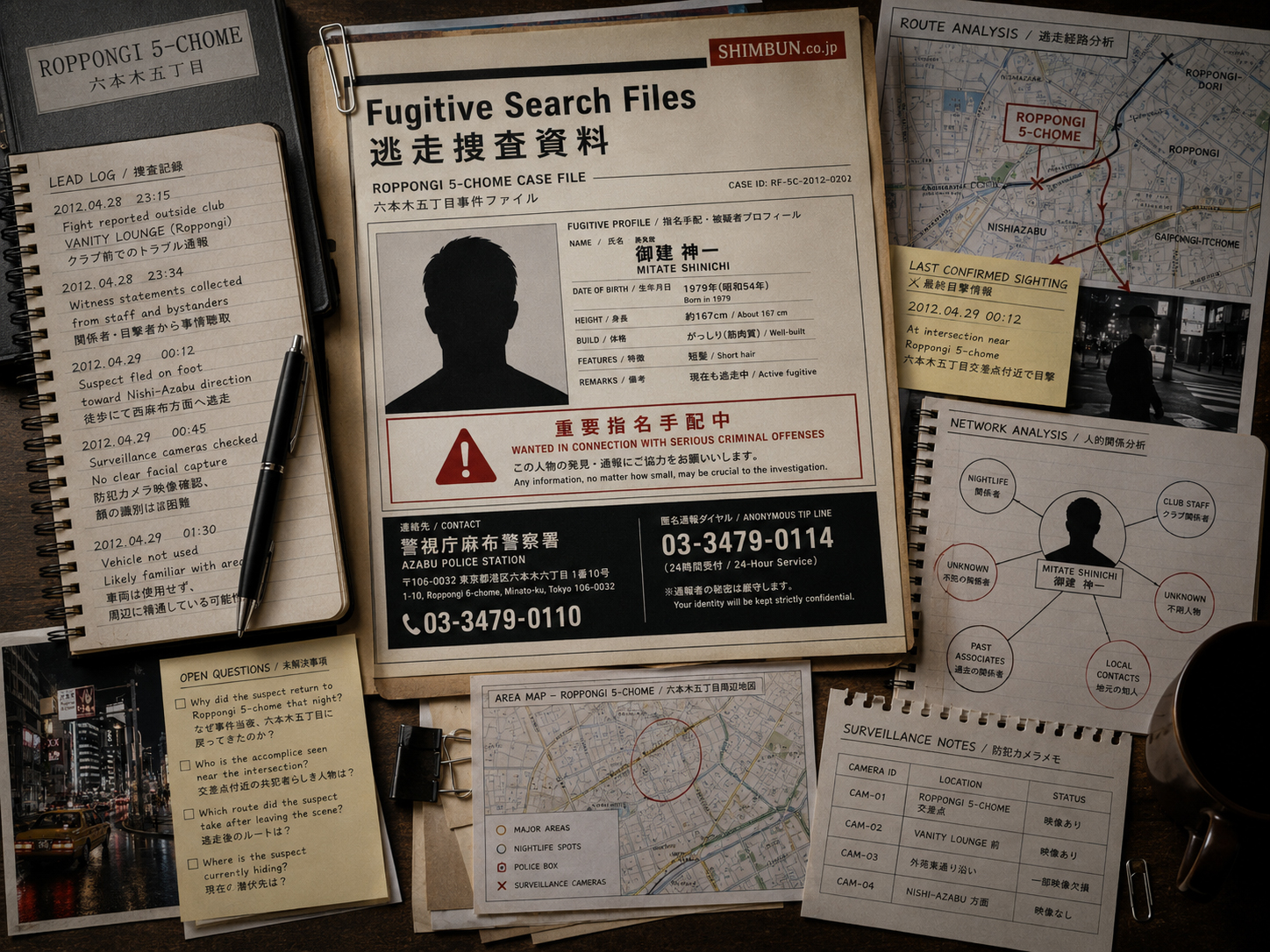
roppongi-5-chome-fugitive-search-files.jpgFugitive search files — Lead log, maps, open questions and profile file.
roppongi-5-chome-cold-case-season-closer.jpgSeason closer — Final cold-case cover image: still unresolved, active fugitive.
Main sources
- Tokyo Metropolitan Police Department, Japanese case page — date, place, suspect features, reward and contact information.
- Tokyo Metropolitan Police Department, English wanted page — active fugitive status, possible domestic hiding prefectures, reward period.
- National Police Agency, Most wanted suspects designated by the NPA — Mitate entry and Azabu Police contact.
- Nippon.com, “The Upstart Gangs Filling the Yakuza Power Vacuum” — hangure and Kantō Rengō context.
- Tokyo Reporter, 2013 wanted poster report — secondary reporting on the Philippines lead.
- Yomiuri TV / Miyaneya explainer — later reporting on the case, trials and context.