Editorial Promise
The Teigin Incident is not only a crime file. It is a justice file: poison, public authority, confession, conviction, death penalty, retrial efforts, and the limits of certainty.
SHIMBUN.co.jp does not treat this case as a simple “who did it?” mystery. We do not declare Sadamichi Hirasawa guilty or innocent by editorial instinct. This page separates the crime, the judgment, the doubts, and the unknowns.
断定ではなく、分離。事件、判決、疑問、未解明部分を混ぜない。
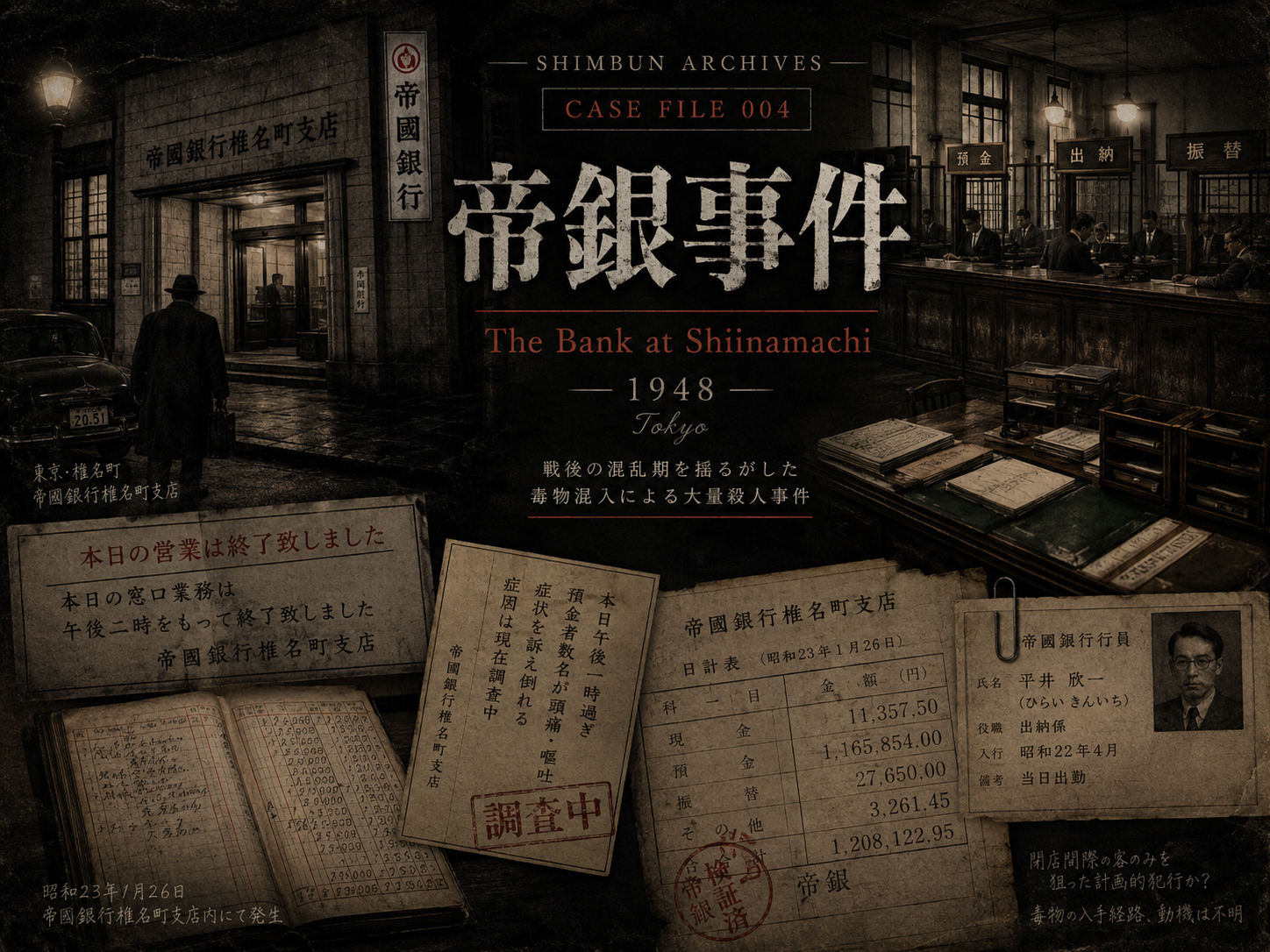
The Shape of the Case
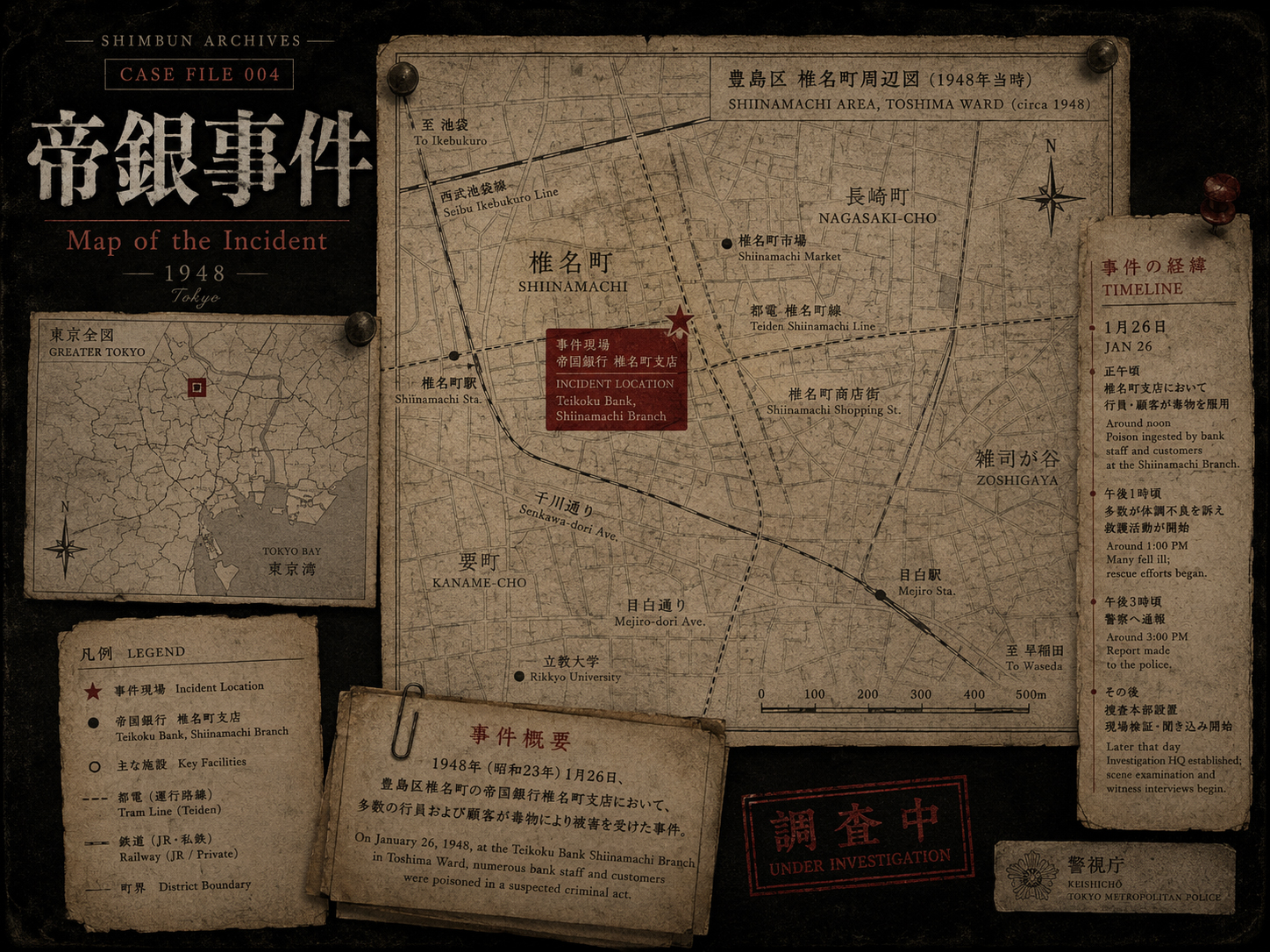
On January 26, 1948, a man claiming to be connected to public-health work entered the Imperial Bank Shiinamachi branch in Tokyo. He reportedly explained that preventive medicine was needed because of a disease scare, and bank staff and others ingested liquid presented as medicine.
Many collapsed. Twelve died. Money was stolen. The incident became one of postwar Japan’s most notorious poisoning-robbery cases.
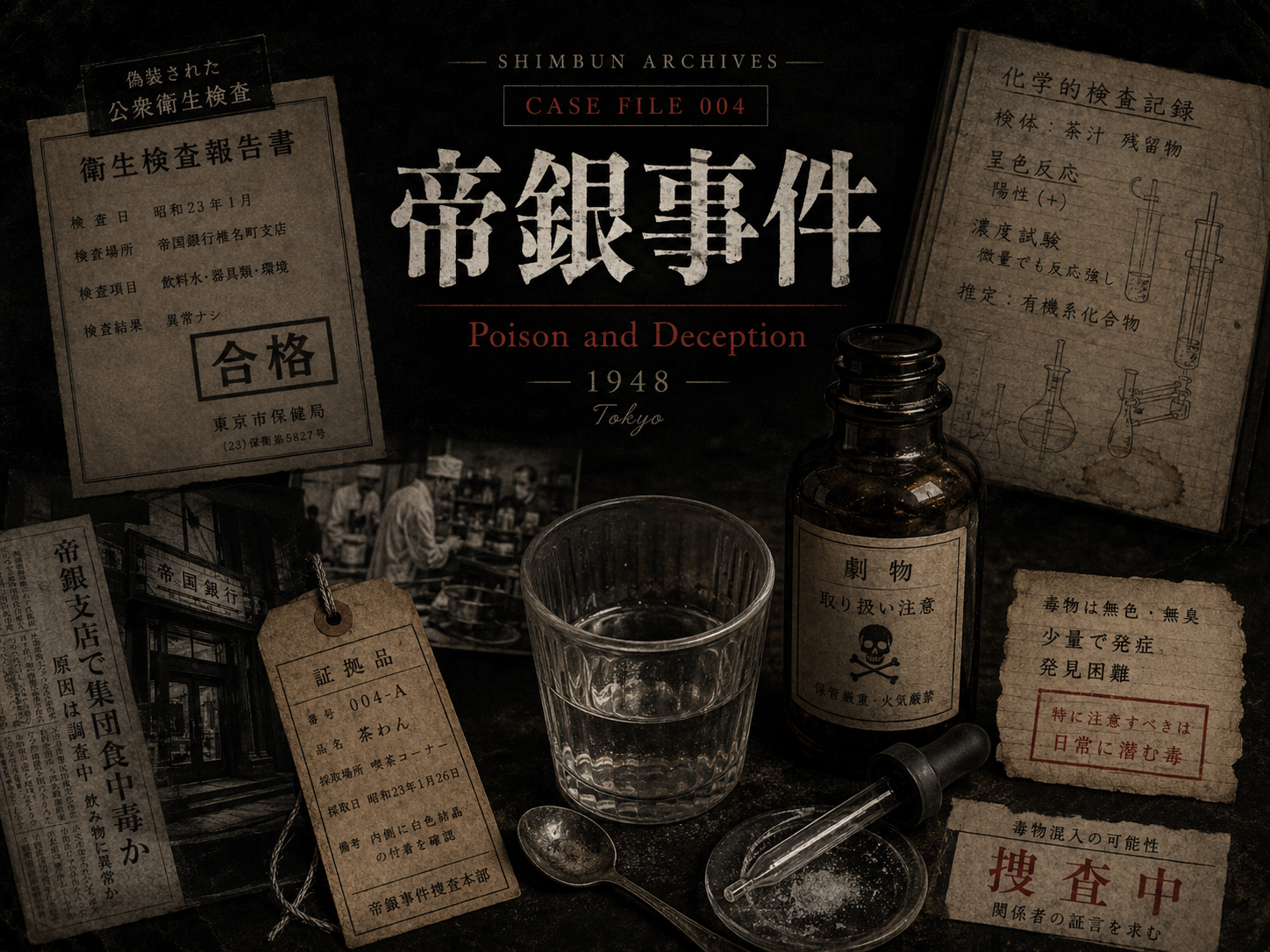
Why It Belongs as Case File 004
Case 001 was the perfect-crime heist. Case 002 was corporate extortion and media fear. Case 003 was a modern forensic cold case. Case 004 is different: the Teigin Incident asks what happens when the state, the court, and public memory cannot fully agree on what justice proved.
Hirasawa was convicted and sentenced to death, but he continued to maintain his innocence. He died in prison in 1987 without execution. The case continued through retrial efforts, public debate, and research into poison, wartime science, and postwar investigation.
Four archive axes
1Mass poisoning and robbery
2Deception through public-health authority
3Hirasawa’s conviction and death sentence
4Retrial efforts and the question of wrongful conviction
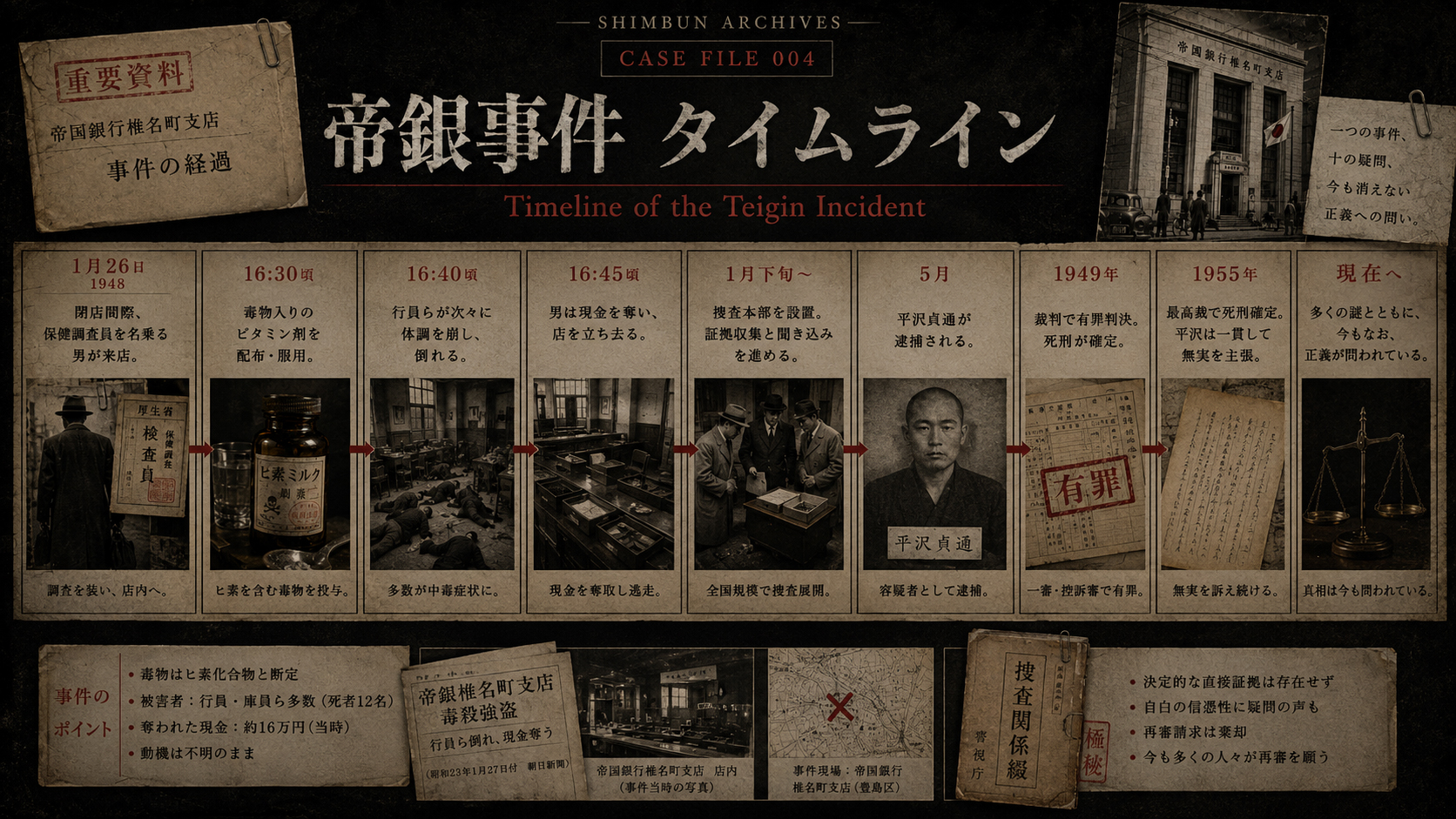
Timeline
The Teigin Incident did not end on the day of the poisoning. Its timeline runs through investigation, arrest, conviction, death sentence, retrial requests, and a justice question that still has not fully disappeared.
A man claiming public-health authority arrives at the Shiinamachi branch.
Liquid presented as preventive medicine is administered to bank staff and others.
After people collapse, money is taken from the bank.
The artist Sadamichi Hirasawa is arrested as a suspect.
Hirasawa is convicted and sentenced to death.
Hirasawa dies in prison without execution.
The crime, evidence, confession, poison, and postwar context remain subjects of debate.
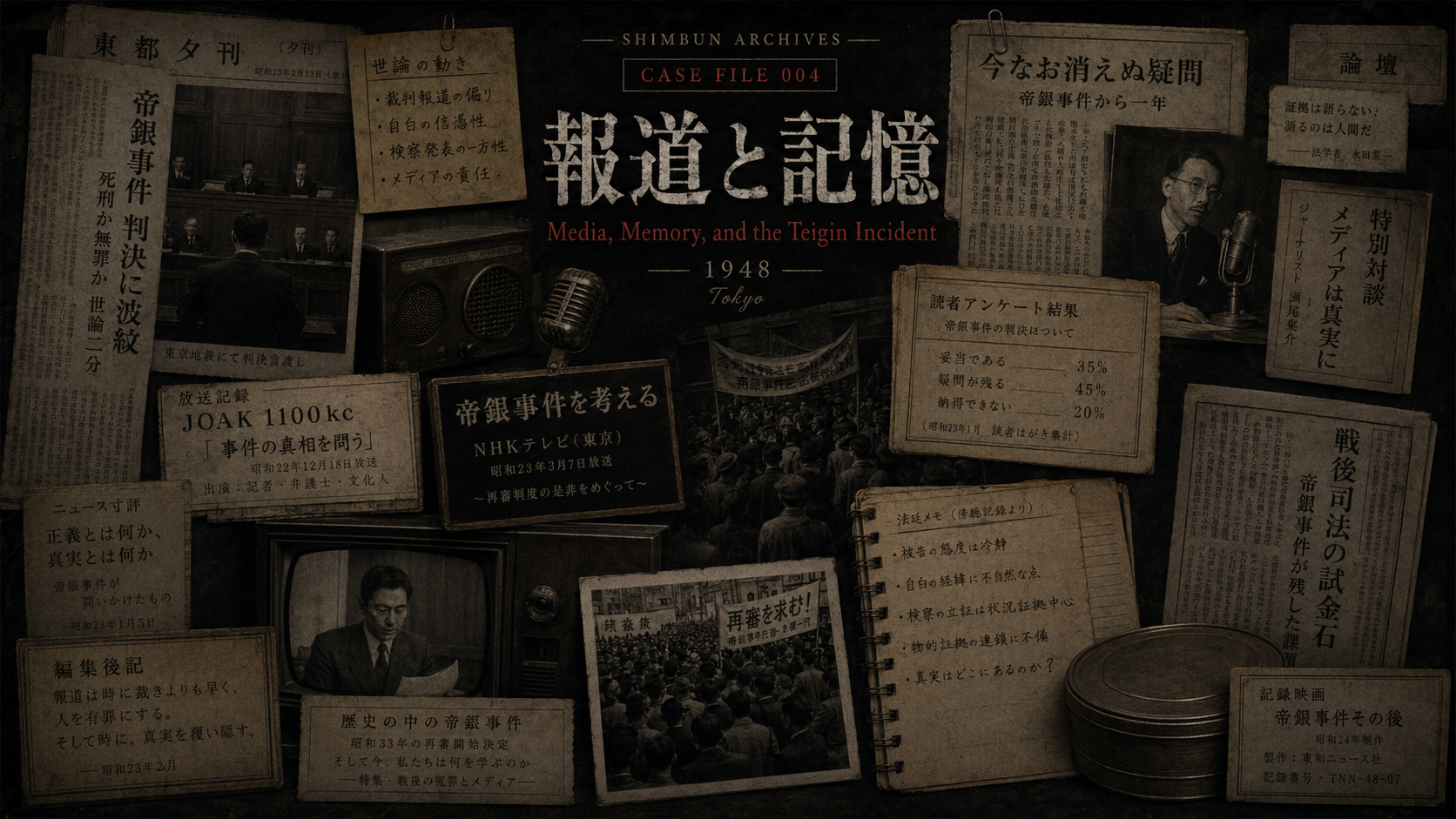
Media, Memory, and Justice
The Teigin Incident lived through newspapers, radio, courtroom reporting, books, films, research exhibitions, and retrial movements. Each layer changed how the public understood Hirasawa, the police investigation, and the court’s certainty.
The key archive rule is simple: what was reported is not always what was proven. What was judged is not always what stopped being questioned.
Source Notes
This page is built from public historical materials, reporting, and research institution material. Claims that cannot be fixed are treated as disputed or unknown.
- Public historical and research materials on the Teigin Incident
- Meiji University Noborito Institute for Peace Education Museum materials and lectures related to the Teigin Incident
- Reporting on the crime, trial, conviction, retrial efforts, and Hirasawa’s death in prison
- Publicly available materials on wartime poison research and postwar justice debates